İHALE DÜNYASI
İHALE DÜNYASI
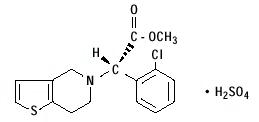
Clopidogrel bisulfate, USP is a thienopyridine class inhibitor of P2Y12 ADP platelet receptors. Chemically it is methyl (+)-(S)-?-(2-chlorophenyl)-6,7-dihydrothieno[3,2-c]pyridine-5(4H) acetate sulfate (1:1). The empirical formula of clopidogrel bisulfate is C16H16ClNO2S*H2SO4 and its molecular weight is 419.9. The structural formula is as follows: Clopidogrel bisulfate, USP is a white to off-white powder. It is practically insoluble in water at neutral pH but freely soluble at pH 1. It also dissolves freely in methanol, dissolves sparingly in methylene chloride, and is practically insoluble in ethyl ether. It has a specific optical rotation of about +56°. Clopidogrel tablets USP, 75 mg for oral administration is provided as either pink, round, biconvex, debossed, film-coated tablets containing 97.875 mg of clopidogrel bisulfate which is the molar equivalent of 75 mg of clopidogrel base. Each tablet contains lactose monohydrate, low substituted hydroxypropyl cellulose, colloidal silicon dioxide, dimethicone and hydrogenated castor oil as inactive ingredients. The pink film coating contains hypromellose 2910, polyethylene glycol 400, titanium dioxide and iron oxide red. clopidogrel.jpg
Indictaions and Usage 1.1 Acute Coronary Syndrome (ACS) * Clopidogrel is indicated to reduce the rate of myocardial infarction (MI) and stroke in patients with non-ST-segment elevation ACS [unstable angina (UA)/non-ST-elevation myocardial infarction (NSTEMI)], including patients who are to be managed medically and those who are to be managed with coronary revascularization. Clopidogrel should be administered in conjunction with aspirin. * Clopidogrel is indicated to reduce the rate of myocardial infarction and stroke in patients with acute ST-elevation myocardial infarction (STEMI) who are to be managed medically. Clopidogrel should be administered in conjunction with aspirin. 1.2 Recent MI, Recent Stroke, or Established Peripheral Arterial Disease In patients with established peripheral arterial disease or with a history of recent myocardial infarction (MI) or recent stroke clopidogrel is indicated to reduce the rate of MI and stroke.
2.1 Acute Coronary Syndrome In patients who need an antiplatelet effect within hours, initiate clopidogrel with a single 300-mg oral loading dose and then continue at 75 mg once daily. Initiating clopidogrel without a loading dose will delay establishment of an antiplatelet effect by several days [see Clinical Pharmacology (12.3) and Clinical Studies (14.1)]. 2.2 Recent MI, Recent Stroke, or Established Peripheral Arterial Disease 75 mg once daily orally without a loading dose [see Clinical Pharmacology (12.3) and Clinical Studies (14.2)].
Contraindictaions 4.1 Active Bleeding Clopidogrel tablets are contraindicated in patients with active pathological bleeding such as peptic ulcer or intracranial hemorrhage. 4.2 Hypersensitivity Clopidogrel tablets are contraindicated in patients with hypersensitivity (e.g., anaphylaxis) to clopidogrel or any component of the product [see Adverse Reactions (6.2)].
The following serious adverse reactions are discussed below and elsewhere in the labeling: * Bleeding [see Warnings and Precautions (5.2)] * Thrombotic thrombocytopenic purpura [see Warnings and Precautions (5.4)] 6.1 Clinical Studies Experience Because clinical trials are conducted under widely varying conditions and durations of follow up, adverse reaction rates observed in the clinical trials of a drug cannot be directly compared to rates in the clinical trials of another drug and may not reflect the rates observed in practice. Clopidogrel has been evaluated for safety in more than 54,000 patients, including over 21,000 patients treated for one year or more. The clinically important adverse reactions observed in trials comparing clopidogrel plus aspirin to placebo plus aspirin and trials comparing clopidogrel alone to aspirin alone are discussed below. Bleeding CURE In CURE, clopidogrel use with aspirin was associated with an increase in major bleeding (primarily gastrointestinal and at puncture sites) compared to placebo with aspirin (see Table 1). The incidence of intracranial hemorrhage (0.1%) and fatal bleeding (0.2%) were the same in both groups. Other bleeding events that were reported more frequently in the clopidogrel group were epistaxis, hematuria, and bruise. The overall incidence of bleeding is described in Table 1. Table 1: CURE Incidence of Bleeding Complications (% patients) Event clopidogrel (+ aspirin) Placebo (+ aspirin) (n=6259) (n=6303) Major bleeding? 3.7 2.7 Life-threatening bleeding 2.2 1.8 Fatal 0.2 0.2 5 g/dL hemoglobin drop 0.9 0.9 Requiring surgical intervention 0.7 0.7 Hemorrhagic strokes 0.1 0.1 Requiring inotropes 0.5 0.5 Requiring transfusion (?4 units) 1.2 1.0 Other major bleeding 1.6 1.0 Significantly disabling 0.4 0.3 Intraocular bleeding with significant loss of vision 0.05 0.03 Requiring 2-3 units of blood 1.3 0.9 Minor bleeding¶ 5.1 2.4 ? Life-threatening and other major bleeding. ¶ Led to interruption of study medication. COMMIT In COMMIT, similar rates of major bleeding were observed in the clopidogrel and placebo groups, both of which also received aspirin (see Table 2). Table 2: Incidence of Bleeding Events in COMMIT (% patients) Type of bleeding Clopidogrel (+ aspirin) (n=22961) Placebo (+ aspirin) (n=22891) p-value Major* noncerebral or cerebral bleeding 0.6 0.5 0.59 Major noncerebral 0.4 0.3 0.48 Fatal 0.2 0.2 0.90 Hemorrhagic stroke 0.2 0.2 0.91 Fatal 0.2 0.2 0.81 Other noncerebral bleeding (non-major) 3.6 3.1 0.005 Any noncerebral bleeding 3.9 3.4 0.004 * Major bleeds were cerebral bleeds or non-cerebral bleeds thought to have caused death or that required transfusion. CAPRIE (Clopidogrel vs. Aspirin) In CAPRIE, gastrointestinal hemorrhage occurred at a rate of 2.0% in those taking clopidogrel vs. 2.7% in those taking aspirin; bleeding requiring hospitalization occurred in 0.7% and 1.1%, respectively. The incidence of intracranial hemorrhage was 0.4% for clopidogrel compared to 0.5% for aspirin. Other bleeding events that were reported more frequently in the clopidogrel group were epistaxis and hematoma. Other Adverse Events In CURE and CHARISMA, which compared clopidogrel plus aspirin to aspirin alone, there was no difference in the rate of adverse events (other than bleeding) between clopidogrel and placebo. In CAPRIE, which compared clopidogrel to aspirin, pruritus was more frequently reported in those taking clopidogrel. No other difference in the rate of adverse events (other than bleeding) was reported. 6.2 Postmarketing Experience The following adverse reactions have been identified during post-approval use of clopidogrel. Because these reactions are reported voluntarily from a population of an unknown size, it is not always possible to reliably estimate their frequency or establish a causal relationship to drug exposure. Hemorrhages, including those with fatal outcome, have been reported in patients treated with clopidogrel * Blood and lymphatic system disorders: Agranulocytosis, aplastic anemia/pancytopenia, thrombotic thrombocytopenic purpura (TTP), acquired hemophilia A * Gastrointestinal disorders: Colitis (including ulcerative or lymphocytic colitis), pancreatitis, stomatitis, gastric/duodenal ulcer, diarrhea * General disorders and administration site condition: Fever * Hepato-biliary disorders: Acute liver failure, hepatitis (non-infectious), abnormal liver function test * Immune system disorders: Hypersensitivity reactions, anaphylactoid reactions, serum sickness * Musculoskeletal, connective tissue and bone disorders: Myalgia, arthralgia, arthritis * Nervous system disorders: Taste disorders, headache * Psychiatric disorders: Confusion, hallucinations * Respiratory, thoracic and mediastinal disorders: Bronchospasm, interstitial pneumonitis, eosinophilic pneumonia * Renal and urinary disorders: Increased creatinine levels * Skin and subcutaneous tissue disorders: Maculopapular, erythematous or exfoliative rash, urticaria, bullous dermatitis, eczema, toxic epidermal necrolysis, Stevens-Johnson syndrome, acute generalized exanthematous pustulosis (AGEP), angioedema, drug-induced hypersensitivity syndrome, drug rash with eosinophilia and systemic symptoms (DRESS), erythema multiforme, lichen planus, generalized pruritus * Vascular disorders: Vasculitis, hypotension
5.1 Diminished Antiplatelet Activity in Patients with Impaired CYP2C19 Function Clopidogrel is a prodrug. Inhibition of platelet aggregation by clopidogrel is achieved through an active metabolite. The metabolism of clopidogrel to its active metabolite can be impaired by genetic variations in CYP2C19 [seeBOXED WARNING]. The metabolism of clopidogrel can also be impaired by drugs that inhibit CYP2C19, such as omeprazole or esomeprazole. Avoid concomitant use of clopidogrel with omeprazole or esomeprazole because both significantly reduce the antiplatelet activity of clopidogrel [see Drug Interactions (7.1)]. 5.2 General Risk of Bleeding Thienopyridines, including clopidogrel, increase the risk of bleeding. Thienopyridines inhibit platelet aggregation for the lifetime of the platelet (7-10 days). Because the half-life of clopidogrel's active metabolite is short, it may be possible to restore hemostasis by administering exogenous platelets; however, platelet transfusions within 4 hours of the loading dose or 2 hours of the maintenance dose may be less effective. 5.3 Discontinuation of clopidogrel tablets Discontinuation of clopidogrel increases the risk of cardiovascular events. If clopidogrel must be temporarily discontinued (e.g., to treat bleeding or for surgery with a major risk of bleeding), restart it as soon as possible.When possible, interrupt therapy with clopidogrel for five days prior to such surgery. Resume clopidogrel as soon as hemostasis is achieved. 5.4 Thrombotic Thrombocytopenic Purpura (TTP) TTP, sometimes fatal, has been reported following use of clopidogrel, sometimes after a short exposure (<2 weeks). TTP is a serious condition that requires urgent treatment including plasmapheresis (plasma exchange). It is characterized by thrombocytopenia, microangiopathic hemolytic anemia (schistocytes [fragmented RBCs] seen on peripheral smear), neurological findings, renal dysfunction, and fever [see Adverse Reactions (6.2)]. 5.5 Cross-Reactivity among Thienopyridines Hypersensitivity including rash, angioedema or hematologic reaction have been reported in patients receiving clopidogrel, including patients with a history of hypersensitivity or hematologic reaction to other thienopyridines [see Contraindications (4.2) and Adverse Reactions (6.2)]. --- BOXED WARNING: BOXED WARNING WARNING:DIMINISHED ANTIPLATELET EFFECT IN PATIENTS WITH TWO LOSS-OF-FUNCTION ALLELES OF THE CYP2C19 GENE The effectiveness of Clopidogrel results from its antiplatelet activity, which is dependent on its conversion to an active metabolite by the cytochrome P450 (CYP) system, principally CYP2C19 [see Warnings and Precautions (5.1), Clinical Pharmacology (12.3)]. Clopidogrel at recommended doses forms less of the active metabolite and so has a reduced effect on platelet activity in patients who are homozygous for nonfunctional alleles of the CYP2C19 gene, (termed "CYP2C19 poor metabolizers"). Tests are available to identify patients who are CYP2C19 poor metabolizers [see Clinical Pharmacology (12.5)]. Consider use of another platelet P2Y12 inhibitor in patients identified as CYP2C19 poor metabolizers.
7.1 CYP2C19 Inhibitors Clopidogrel is metabolized to its active metabolite in part by CYP2C19. Concomitant use of drugs that inhibit the activity of this enzyme results in reduced plasma concentrations of the active metabolite of clopidogrel and a reduction in platelet inhibition [see Warnings and Precautions (5.1)]. Omeprazole or esomeprazole Avoid concomitant use of clopidogrel with omeprazole or esomeprazole. In clinical studies, omeprazole was shown to reduce significantly the antiplatelet activity of clopidogrel when given concomitantly or 12 hours apart. A similar reduction in antiplatelet activity was observed with esomeprazole when given concomitantly with clopidogrel. Dexlansoprazole, lansoprazole and pantoprazole had less effect on the antiplatelet activity of clopidogrel than did omeprazole or esomeprazole [see Warnings and Precautions (5.1) and Clinical Pharmacology (12.3)]. 7.2 Nonsteroidal Anti-Inflammatory Drugs (NSAIDs) Coadministration of clopidogrel and NSAIDs increases the risk of gastrointestinal bleeding. 7.3 Warfarin (CYP2C9 Substrates) Although the administration of clopidogrel 75 mg per day did not modify the pharmacokinetics of S-warfarin (a CYP2C9 substrate) or INR in patients receiving long-term warfarin therapy, coadministration of clopidogrel with warfarin increases the risk of bleeding because of independent effects on hemostasis. However, at high concentrations in vitro, clopidogrel inhibits CYP2C9. 7.4 SSRIs and SNRIs Since selective serotonin reuptake inhibitors (SSRIs) and serotonin norepinephrine reuptake inhibitors (SNRIs) affect platelet activation, the concomitant administration of SSRIs and SNRIs with clopidogrel may increase the risk of bleeding. 7.5 Repaglinide (CYP2C8 Substrates) The acyl-?-glucuronide metabolite of clopidogrel is a strong inhibitor of CYP2C8. Clopidogrel can increase the systemic exposure to drugs that are primarily cleared by CYP2C8, thereby needing dose-adjustment and appropriate monitoring. Clopidogrel increased repaglinide exposures by 3.9-to 5.1-fold [see Clinical Pharmacology (12.3)]. Avoid concomitant use of repaglinide with clopidogrel. If concomitant use cannot be avoided, initiate repaglinide at 0.5 mg before each meal and do not exceed a total daily dose of 4 mg. Increased frequency of glucose monitoring may be required during concomitant use.