
İHALE DÜNYASI
İHALE DÜNYASI
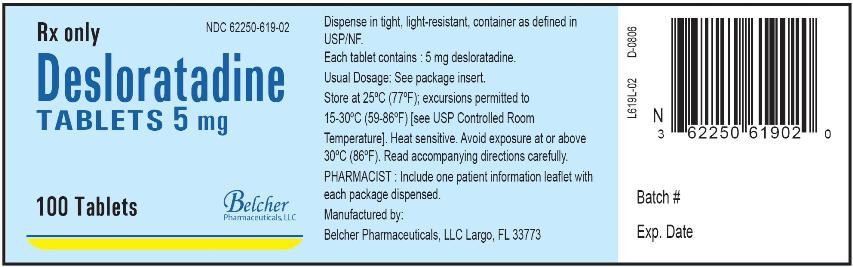
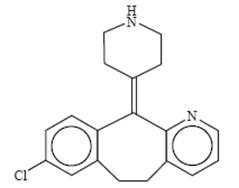
Desloratadine Tablets are light blue, round, tablets containing 5 mg desloratadine, an antihistamine, to be administered orally. Desloratadine Tablets also contain the following inactive ingredients: microcrystalline cellulose NF, pregelatinized starch NF, croscarmellose sodium NF, talc USP, zinc stearate, USP and FD&C Blue#2 HT 11-14%. Desloratadine is a white to off-white powder that is slightly soluble in water, but very soluble in ethanol and propylene glycol. It has an empirical formula: C 19 H 19 ClN 2 and a molecular weight of 310.8. The chemical name is 8-chloro-6,11-dihydro-11-(4-piperdinylidene)- 5H -benzo[5,6]cyclohepta[1,2-b]pyridine and has the following structure: 7ed3d659-figure-01
Desloratadine Tablets are indicated for: Seasonal Allergic Rhinitis: relief of nasal and non-nasal symptoms in patients 12 years of age and older. ( 1.1 ) Perennial Allergic Rhinitis: relief of nasal and non-nasal symptoms in patients 12 years of age and older. ( 1.2 ) Chronic Idiopathic Urticaria: symptomatic relief of pruritus reduction in the number of hives, and size of hives in patients 12 years of age and older. ( 1.3 ) 1.1 Seasonal Allergic Rhinitis Desloratadine Tablets are indicated for the relief of the nasal and non-nasal symptoms of seasonal allergic rhinitis in patients 12 years of age and older. 1.2 Perennial Allergic Rhinitis Desloratadine Tablets are indicated for the relief of the nasal and non-nasal symptoms of perennial allergic rhinitis in patients 12 years of age and older. 1.3 Chronic Idiopathic Urticaria Desloratadine Tablets are indicated for the symptomatic relief of pruritus, reduction in the number of hives, and size of hives, in patients with chronic idiopathic urticaria 12 years of age and older.
Desloratadine Tablets may be taken without regard to meals. Dosage (by age): Adults and adolescents 12 years of age and over: Desloratadine Tablets - one 5 mg tablet once daily 2.1 Adults and adolescents 12 years of age and over The recommended dose of Desloratadine Tablets is one 5-mg tablet once daily. 2.5 Adults with Hepatic or Renal Impairment In adult patients with liver or renal impairment, a starting dose of one 5 mg tablet every other day is recommended based on pharmacokinetic data. Dosing recommendation for children with liver or renal impairment cannot be made due to lack of data [see Clinical Pharmacology ( 12.3 )].
Desloratadine Tablets are contraindicated in patients who are hypersensitive to this medication or to any of its ingredients or to loratadine [see Warnings and Precautions ( 5.1 ) and Adverse Reactions ( 6.2 )]. Hypersensitivity ( 4 , 6.2 )
The following adverse reactions are discussed in greater detail in other sections of the label: Hypersensitivity reactions. [See Warnings and Precautions ( 5.1 ).] The most common adverse reactions (reported in ?2% of adult and adolescent patients with allergic rhinitis and greater than placebo) were pharyngitis, dry mouth, myalgia, fatigue, somnolence, dysmenorrhea. ( 6.1 ) To report SUSPECTED ADVERSE REACTIONS, contact Belcher Pharmaceuticals LLC at 1-727-471-0850 or FDA at 1-800-FDA-1088 or www.fda.gov/medwatch. 6.1 Clinical Trials Experience Because clinical trials are conducted under widely varying conditions, adverse reaction rates observed in the clinical trials of a drug cannot be directly compared to rates in the clinical trials of another drug and may not reflect the rates observed in clinical practice. Adults and Adolescents Allergic Rhinitis: In multiple-dose placebo-controlled trials, 2,834 patients ages 12 years or older received Desloratadine Tablets at doses of 2.5 mg to 20 mg daily, of whom 1,655 patients received the recommended daily dose of 5 mg. In patients receiving 5 mg daily, the rate of adverse events was similar between Desloratadine and placebo-treated patients. The percent of patients who withdrew prematurely due to adverse events was 2.4% in the Desloratadine group and 2.6% in the placebo group. There were no serious adverse events in these trials in patients receiving desloratadine. All adverse events that were reported by greater than or equal to 2% of patients who received the recommended daily dose of Desloratadine Tablets (5 mg once daily), and that were more common with Desloratadine Tablets than placebo, are listed in Table 1. Table 1Incidence of Adverse Events Reported by ?2% of Adult and Adolescent AllergicRhinitis Patients Receiving Desloratadine Tablets Adverse Event Desloratadine Tablets 5 mg (n=1,655) Placebo (n=1,652) Infections and Infestations Pharyngitis 4.1% 2.0% Nervous System Disorders Somnolence 2.1% 1.8% Gastrointestinal Disorders Dry Mouth 3.0% 1.9% Musculoskeletal and Connective Tissue Disorders Myalgia 2.1% 1.8% Reproductive System and Breast Disorders Dysmenorrhea 2.1% 1.6% General Disorders and Administration Site Conditions Fatigue 2.1% 1.2% The frequency and magnitude of laboratory and electrocardiographic abnormalities were similar in Desloratadine and placebo-treated patients. There were no differences in adverse events for subgroups of patients as defined by gender, age, or race. Chronic Idiopathic Urticaria: In multiple-dose, placebo-controlled trials of chronic idiopathic urticaria, 211 patients ages 12 years or older received Desloratadine Tablets and 205 received placebo. Adverse events that were reported by greater than or equal to 2% of patients who received Desloratadine Tablets and that were more common with Desloratadine than placebo were (rates for Desloratadine and placebo, respectively): headache (14%, 13%), nausea (5%, 2%), fatigue (5%, 1%), dizziness (4%, 3%), pharyngitis (3%, 2%), dyspepsia (3%, 1%), and myalgia (3%, 1%). Pediatrics Two hundred and forty-six pediatric subjects 6 months to 11 years of age received Desloratadine Oral Solution for 15 days in three placebo controlled clinical trials. Pediatric subjects aged 6 to 11 years received 2.5 mg once a day, subjects aged 1 to 5 years received 1.25 mg once a day, and subjects 6 to 11 months of age received 1.0 mg once a day. In subjects 6 to 11 years of age, no individual adverse event was reported by 2 percent or more of the subjects. In subjects 2 to 5 years of age, adverse events reported for Desloratadine and placebo in at least 2 percent of subjects receiving Desloratadine Oral Solution and at a frequency greater than placebo were fever (5.5%, 5.4%), urinary tract infection (3.6%, 0%) and varicella (3.6%, 0%). In subjects 12 months to 23 months of age, adverse events reported for the Desloratadine product and placebo in at least 2 percent of subjects receiving Desloratadine Oral Solution and at a frequency greater than placebo were fever (16.9%, 12.9%), diarrhea (15.4%, 11.3%), upper respiratory tract infections (10.8%, 9.7%), coughing (10.8%, 6.5%), appetite increased (3.1%, 1.6%), emotional lability (3.1%, 0%), epistaxis (3.1%, 0%), parasitic infection (3.1%, 0%), pharyngitis (3.1%, 0%), rash maculopapular (3.1%, 0%). In subjects 6 months to 11 months of age, adverse events reported for Desloratadine and placebo in at least 2 percent of subjects receiving Desloratadine Oral Solution and at a frequency greater than placebo were upper respiratory tract infections (21.2%, 12.9%), diarrhea (19.7%, 8.1%), fever (12.1%, 1.6%), irritability (12.1%, 11.3%), coughing (10.6%, 9.7%), somnolence (9.1%, 8.1%), bronchitis (6.1%, 0%), otitis media (6.1%, 1.6%), vomiting (6.1%, 3.2%), anorexia (4.5%, 1.6%), pharyngitis (4.5%, 1.6%), insomnia (4.5%, 0%), rhinorrhea (4.5%, 3.2%), erythema (3.0%, 1.6%), and nausea (3.0%, 0%). There were no clinically meaningful changes in any electrocardiographic parameter, including the QTc interval. Only one of the 246 pediatric subjects receiving Desloratadine Oral Solution in the clinical trials discontinued treatment because of an adverse event. 6.2 Post-Marketing Experience Because adverse events are reported voluntarily from a population of uncertain size, it is not always possible to reliably estimate their frequency or establish a causal relationship to drug exposure. The following spontaneous adverse events have been reported during the marketing of desloratadine: tachycardia, palpitations, rare cases of hypersensitivity reactions (such as rash, pruritus, urticaria, edema, dyspnea, and anaphylaxis), psychomotor hyperactivity, seizures, and elevated liver enzymes including bilirubin, and very rarely, hepatitis.
Hypersensitivity reactions including rash, pruritus, urticaria, edema, dyspnea, and anaphylaxis have been reported. In such cases, stop Desloratadine Tablets at once and consider alternative treatments. ( 5.1 ) 5.1 Hypersensitivity Reactions Hypersensitivity reactions including rash, pruritus, urticaria, edema, dyspnea, and anaphylaxis have been reported after administration of desloratadine. If such a reaction occurs, therapy with Desloratadine should be stopped and alternative treatment should be considered. [See Adverse Reactions ( 6.2 ).]
7.1 Inhibitors of Cytochrome P450 3A4 In controlled clinical studies co-administration of desloratadine with ketoconazole, erythromycin, or azithromycin resulted in increased plasma concentrations of desloratadine and 3 hydroxydesloratadine, but there were no clinically relevant changes in the safety profile of desloratadine. [See Clinical Pharmacology ( 12.3 ).] 7.2 Fluoxetine In controlled clinical studies co-administration of desloratadine with fluoxetine, a selective serotonin reuptake inhibitor (SSRI), resulted in increased plasma concentrations of desloratadine and 3 hydroxydesloratadine, but there were no clinically relevant changes in the safety profile of desloratadine. [See Clinical Pharmacology ( 12.3 ).] 7.3 Cimetidine In controlled clinical studies co-administration of desloratadine with cimetidine, a histamine H2-receptor antagonist, resulted in increased plasma concentrations of desloratadine and 3 hydroxydesloratadine, but there were no clinically relevant changes in the safety profile of desloratadine. [See Clinical Pharmacology ( 12.3 ).]