
İHALE DÜNYASI
İHALE DÜNYASI

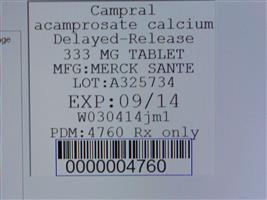
Campral (acamprosate calcium) is supplied in an enteric-coated tablet for oral administration. Acamprosate calcium is a synthetic compound with a chemical structure similar to that of the endogenous amino acid homotaurine, which is a structural analogue of the amino acid neurotransmitter ?-aminobutyric acid and the amino acid neuromodulator taurine. Its chemical name is calcium acetylaminopropane sulfonate. Its chemical formula is C H N O S Ca and molecular weight is 400.48. Its structural formula is: 10 20 2 8 2 Acamprosate calcium is a white, odorless or nearly odorless powder. It is freely soluble in water, and practically insoluble in absolute ethanol and dichloromethane. Each Campral tablet contains acamprosate calcium 333 mg, equivalent to 300 mg of acamprosate. Inactive ingredients in Campral tablets include: crospovidone, microcrystalline cellulose, magnesium silicate, sodium starch glycolate, colloidal anhydrous silica, magnesium stearate, talc, propylene glycol and Eudragit L 30 D or equivalent. Sulfites were used in the synthesis of the drug substance and traces of residual sulfites may be present in the drug product. (R) Structural Formula
Campral(R) is indicated for the maintenance of abstinence from alcohol in patients with alcohol dependence who are abstinent at treatment initiation. Treatment with Campral should be part of a comprehensive management program that includes psychosocial support. The efficacy of Campral in promoting abstinence has not been demonstrated in subjects who have not undergone detoxification and not achieved alcohol abstinence prior to beginning Campral treatment. The efficacy of Campral in promoting abstinence from alcohol in polysubstance abusers has not been adequately assessed. Campral(R) is indicated for the maintenance of abstinence from alcohol in patients with alcohol dependence who are abstinent at treatment initiation ( , ). 1 14 Treatment with Campral should be part of a comprehensive management program that includes psychosocial support ( ). 1
The recommended dose of Campral is two 333 mg tablets (each dose should total 666 mg) taken three times daily. A lower dose may be effective in some patients. Although dosing may be done without regard to meals, dosing with meals was employed during clinical trials and is suggested in those patients who regularly eat three meals daily. Treatment with Campral should be initiated as soon as possible after the period of alcohol withdrawal, when the patient has achieved abstinence, and should be maintained if the patient relapses. Campral should be used as part of a comprehensive psychosocial treatment program. Recommended dose: 666 mg (two 333 mg tablets) taken three times daily ( ). 2 Dose reduction to one 333 mg tablet taken three times daily for patients with moderate renal impairment (creatinine clearance 30-50 mL/min) ( ). 2.1 Campral is contraindicated in patients with severe renal impairment (creatinine clearance of ?30 mL/min) ( , , , , ). 2.1 4.2 5.1 8.6 12.3 2.1 Dosage in Renal Impairment For patients with moderate renal impairment (creatinine clearance of 30-50 mL/min), a starting dose of one 333 mg tablet taken three times daily is recommended. Campral is contraindicated in patients with severe renal impairment (creatinine clearance of ?30 mL/min) [ and ]. see Contraindications ( ), Warnings and Precautions ( ), Use in Specific Populations ( ), 4.2 5.1 8.6 Clinical Pharmacology ( ) 12.3
Campral is contraindicated in patients who previously have exhibited hypersensitivity to acamprosate calcium or any of its components ( ). 4.1 Campral is contraindicated in patients with severe renal impairment ( ). 4.2 4.1 Hypersensitivity to Acamprosate Calcium Campral is contraindicated in patients who previously have exhibited hypersensitivity to acamprosate calcium or any of its components. 4.2 Severe Renal Impairment Campral is contraindicated in patients with severe renal impairment (creatinine clearance of ?30 mL/min) [ and ]. see Dosage and Administration ( ), Warnings and Precautions ( ), Use in Specific Populations ( ), 2.1 5.1 8.6 Clinical Pharmacology ( ) 12.3
Common adverse events that occurred in any Campral treatment group at a rate of 3% or greater and greater than the placebo group in controlled clinical trials with spontaneously reported adverse events are: accidental injury, asthenia, pain, anorexia, diarrhea, flatulence, nausea, anxiety, depression, dizziness, dry mouth, insomnia, paresthesia, pruritus and sweating ( ). 6.1 . To report SUSPECTED ADVERSE REACTIONS, contact Forest Laboratories, Inc. at 1-800-678-1605, or FDA at 1-800-FDA-1088 or www.fda.gov/medwatch 6.1 Clinical Trials Experience Because clinical trials are conducted under widely varying conditions, adverse reaction rates observed in the clinical trials of a drug cannot be directly compared to rates in the clinical trials of another drug and may not reflect the rates observed in clinical practice. Clinically significant serious adverse reactions associated with Campral described elsewhere in labeling include suicidality and depression and acute kidney failure [s , and ]. ee Warnings and Precautions ( ) 5.2 Adverse Reactions ( ) 6.2 The adverse event data described below reflect the safety experience in over 7000 patients exposed to Campral for up to one year, including over 2000 Campral-exposed patients who participated in placebo-controlled trials. Adverse Events Leading to Discontinuation In placebo-controlled trials of 6 months or less, 8% of Campral-treated patients discontinued treatment due to an adverse event, as compared to 6% of patients treated with placebo. In studies longer than 6 months, the discontinuation rate due to adverse events was 7% in both the placebo-treated and the Campral-treated patients. Only diarrhea was associated with the discontinuation of more than 1% of patients (2% of Campral-treated vs. 0.7% of placebo-treated patients). Other events, including nausea, depression, and anxiety, while accounting for discontinuation in less than 1% of patients, were nevertheless more commonly cited in association with discontinuation in Campral-treated patients than in placebo-treated patients. Common Adverse Events Reported in Controlled Trials Common adverse events were collected spontaneously in some controlled studies and using a checklist in other studies. The overall profile of adverse events was similar using either method. shows those events that occurred in any Campral treatment group at a rate of 3% or greater and greater than the placebo group in controlled clinical trials with spontaneously reported adverse events. The reported frequencies of adverse events represent the proportion of individuals who experienced, at least once, a treatment-emergent adverse event of the type listed, without regard to the causal relationship of the events to the drug. Table 1 Table 1. Events Occurring at a Rate of at Least 3% and Greater than Placebo in any Campral Treatment Group in Controlled Clinical Trials with Spontaneously Reported Adverse Events. Body System/Preferred Term Number of Patients (%) with Events Campral 1332 mg/day Campral 1998 mg/day 1 Campral Pooled 2 Placebo ?*includes events coded as "fracture" by sponsor; ??**includes events coded as "nervousness" by sponsor includes 258 patients treated with acamprosate calcium 2000 mg/day, using a different dosage strength and regimen. 1 includes all patients in the first two columns as well as 83 patients treated with acamprosate calcium 3000 mg/day, using a different dosage strength and regimen. 2 Number of patients in Treatment Group 397 1539 2019 1706 Number (%) of patients with an AE 248 (62%) 910 (59%) 1231 (61%) 955 (56%) Body as a Whole 121 (30%) 513 (33%) 685 (34%) 517 (30%) Accidental Injury*? 17 ( 4%) 44 ( 3%) 70 ( 3%) 52 ( 3%) Asthenia 29 ( 7%) 79 ( 5%) 114 ( 6%) 93 ( 5%) Pain 6 ( 2%) 56 ( 4%) 65 ( 3%) 55 ( 3%) Digestive System 85 (21%) 440 (29%) 574 (28%) 344 (20%) Anorexia 20 ( 5%) 35 ( 2%) 57 ( 3%) 44 ( 3%) Diarrhea 39 (10%) 257 (17%) 329 (16%) 166 (10%) Flatulence 4 ( 1%) 55 ( 4%) 63 ( 3%) 28 ( 2%) Nausea 11 ( 3%) 69 ( 4%) 87 ( 4%) 58 ( 3%) Nervous System 150 (38%) 417 (27%) 598 (30%) 500 (29%) Anxiety??** 32 ( 8%) 80 ( 5%) 118 ( 6%) 98 ( 6%) Depression 33 ( 8%) 63 ( 4%) 102 ( 5%) 87 ( 5%) Dizziness 15 ( 4%) 49 ( 3%) 67 ( 3%) 44 ( 3%) Dry mouth 13 ( 3%) 23 ( 1%) 36 ( 2%) 28 ( 2%) Insomnia 34 ( 9%) 94 ( 6%) 137 ( 7%) 121 ( 7%) Paresthesia 11 ( 3%) 29 ( 2%) 40 ( 2%) 34 ( 2%) Skin and Appendages 26 ( 7%) 150 (10%) 187 ( 9%) 169 (10%) Pruritus 12 ( 3%) 68 ( 4%) 82 ( 4%) 58 ( 3%) Sweating 11 ( 3%) 27 ( 2%) 40 ( 2%) 39 ( 2%) Concomitant Therapies In clinical trials, the safety profile in subjects treated with Campral concomitantly with anxiolytics, hypnotics and sedatives (including benzodiazepines), or non-opioid analgesics was similar to that of subjects taking placebo with these concomitant medications. Patients taking Campral concomitantly with antidepressants more commonly reported both weight gain and weight loss, compared with patients taking either medication alone. Other Events Observed During the Premarketing Evaluation of Campral Following is a list of terms that reflect treatment-emergent adverse events reported by patients treated with Campral in 20 clinical trials (4461 patients treated with Campral, 3526 of whom received the maximum recommended dose of 1998 mg/day for up to one year in duration). This listing does not include those events already listed above; events for which a drug cause was considered remote; event terms which were so general as to be uninformative; and events reported only once which were not likely to be acutely life-threatening. Events are further categorized by body system and listed in order of decreasing frequency according to the following definitions: frequent adverse events are those occurring in at least 1/100 patients (only those not already listed in the summary of adverse events in controlled trials appear in this listing); infrequent adverse events are those occurring in 1/100 to 1/1000 patients; rare events are those occurring in fewer than 1/1000 patients. : headache, abdominal pain, back pain, infection, flu syndrome, chest pain, chills, suicide attempt; : fever, intentional overdose, malaise, allergic reaction, abscess, neck pain, hernia, intentional injury; : ascites, face edema, photosensitivity reaction, abdomen enlarged, sudden death. Body as a Whole - Frequent Infrequent Rare : palpitation, syncope; : hypotension, tachycardia, hemorrhage, angina pectoris, migraine, varicose vein, myocardial infarct, phlebitis, postural hypotension; : heart failure, mesenteric arterial occlusion, cardiomyopathy, deep thrombophlebitis, shock. Cardiovascular System - Frequent Infrequent Rare : vomiting, dyspepsia, constipation, increased appetite; : liver function tests abnormal, gastroenteritis, gastritis, dysphagia, eructation, gastrointestinal hemorrhage, pancreatitis, rectal hemorrhage, liver cirrhosis, esophagitis, hematemesis, nausea and vomiting, hepatitis; melena, stomach ulcer, cholecystitis, colitis, duodenal ulcer, mouth ulceration, carcinoma of liver. Digestive System - Frequent Infrequent Rare: goiter, hypothyroidism. Endocrine System - Rare: : anemia, ecchymosis, eosinophilia, lymphocytosis, thrombocytopenia; leukopenia, lymphadenopathy, monocytosis. Hemic and Lymphatic System - Infrequent Rare: - peripheral edema, weight gain; : weight loss, hyperglycemia, SGOT increased, SGPT increased, gout, thirst, hyperuricemia, diabetes mellitus, avitaminosis, bilirubinemia; alkaline phosphatase increased, creatinine increased, hyponatremia, lactic dehydrogenase increased. Metabolic and Nutritional Disorders - Frequent Infrequent Rare: - myalgia, arthralgia; : leg cramps; rheumatoid arthritis, myopathy. Musculoskeletal System - Frequent Infrequent Rare: -somnolence, libido decreased, amnesia, thinking abnormal, tremor, vasodilatation, hypertension; : convulsion, confusion, libido increased, vertigo, withdrawal syndrome, apathy, suicidal ideation, neuralgia, hostility, agitation, neurosis, abnormal dreams, hallucinations, hypesthesia; : alcohol craving, psychosis, hyperkinesia, twitching, depersonalization, increased salivation, paranoid reaction, torticollis, encephalopathy, manic reaction. Nervous System - Frequent Infrequent Rare : rhinitis, cough increased, dyspnea, pharyngitis, bronchitis; : asthma, epistaxis, pneumonia; laryngismus, pulmonary embolus. Respiratory System - Frequent Infrequent Rare: : rash; : acne, eczema, alopecia, maculopapular rash, dry skin, urticaria, exfoliative dermatitis, vesiculobullous rash; psoriasis. Skin and Appendages - Frequent Infrequent Rare: : abnormal vision, taste perversion; : tinnitus, amblyopia, deafness; ophthalmitis, diplopia, photophobia. Special Senses - Frequent Infrequent Rare: : impotence; - metrorrhagia, urinary frequency, urinary tract infection, sexual function abnormal, urinary incontinence, vaginitis; kidney calculus, abnormal ejaculation, hematuria, menorrhagia, nocturia, polyuria, urinary urgency. Urogenital System - Frequent Infrequent Rare: 6.2 Postmarketing Experience The following adverse reactions have been identified during post approval use of Campral. Because these reactions are reported voluntarily from a population of uncertain size, it is not always possible to reliably estimate their frequency or establish a causal relationship to drug exposure. Serious Adverse Events Observed During the Non-US Postmarketing Evaluation of Campral (acamprosate calcium) The serious adverse event of acute kidney failure has been reported to be temporally associated with Campral treatment in at least 3 patients and is not described elsewhere in the labeling.
Dose reduction is required for patients with moderate renal impairment ( ). 5.1 Monitor patients for depression or suicidal ideation and prompt patients, families, and caregivers to report such symptoms to the health care provider ( ). 5.2 5.1 Renal Impairment Treatment with Campral in patients with moderate renal impairment (creatinine clearance of 30-50 mL/min) requires a dose reduction [ ]. Campral is contraindicated in patients with severe renal impairment (creatinine clearance of ?30 mL/min) [ and ]. see Dosage and Administration ( ) 2.1 see Dosage and Administration ( ), Contraindications ( ), Use in Specific Populations ( ), 2.1 4.2 8.6 Clinical Pharmacology ( ) 12.3 5.2 Suicidality and Depression In controlled clinical trials of Campral, adverse events of a suicidal nature (suicidal ideation, suicide attempts, completed suicides) were infrequent overall, but were more common in Campral-treated patients than in patients treated with placebo (1.4% vs. 0.5% in studies of 6 months or less; 2.4% vs. 0.8% in year-long studies). Completed suicides occurred in 3 of 2272 (0.13%) patients in the pooled acamprosate group from all controlled studies and 2 of 1962 patients (0.10%) in the placebo group. Adverse events coded as "depression" were reported at similar rates in Campral-treated and placebo-treated patients. Although many of these events occurred in the context of alcohol relapse, and the interrelationship between alcohol dependence, depression and suicidality is well-recognized and complex, no consistent pattern of relationship between the clinical course of recovery from alcoholism and the emergence of suicidality was identified. Alcohol-dependent patients, including those patients being treated with Campral, should be monitored for the development of symptoms of depression or suicidal thinking. Families and caregivers of patients being treated with Campral should be alerted to the need to monitor patients for the emergence of symptoms of depression or suicidality, and to report such symptoms to the patient's health care provider. 5.3 Alcohol Withdrawal Use of Campral does not eliminate or diminish withdrawal symptoms.
Acamprosate does not affect the pharmacokinetics of alcohol. The pharmacokinetics of acamprosate are not affected by alcohol, diazepam, or disulfiram, and clinically important interactions between naltrexone and acamprosate were not observed [ ]. see Clinical Pharmacology ( ) 12.3