
İHALE DÜNYASI
İHALE DÜNYASI
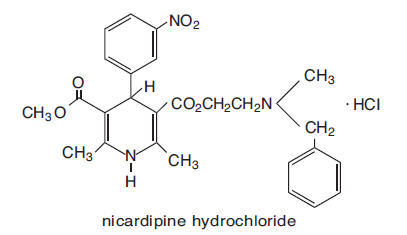
CARDENE SR is a sustained release formulation of CARDENE . CARDENE SR capsules for oral administration each contain 30 mg, 45 mg or 60 mg of nicardipine hydrochloride. Nicardipine hydrochloride is a calcium ion influx inhibitor (slow channel blocker or calcium entry blocker). (R) (R) Nicardipine hydrochloride is a dihydropyridine derivative with the IUPAC (International Union of Pure and Applied Chemistry) chemical name (±)-2-(benzyl-methyl amino) ethyl methyl 1,4-dihydro-2,6 dimethyl-4-(m-nitrophenyl)-3, 5-pyridinedicarboxylate monohydrochloride, and it has the following structure: Nicardipine hydrochloride is a greenish-yellow, odorless, crystalline powder that melts at about 169°C. It is freely soluble in chloroform, methanol and glacial acetic acid, sparingly soluble in anhydrous ethanol, slightly soluble in n-butanol, water, 0.01 M potassium dihydrogen phosphate, acetone and dioxane, very slightly soluble in ethyl acetate, and practically insoluble in benzene, ether and hexane. It has a molecular weight of 515.99. CARDENE SR is available in hard gelatin capsules containing 30 mg, 45 mg or 60 mg nicardipine hydrochloride. All strengths contain a two component capsule fill. A powder component containing 25% of total nicardipine hydrochloride dose contains pregelatinized starch and magnesium stearate as inactive ingredients. A spherical granule component containing 75% of total nicardipine hydrochloride dose also contains microcrystalline cellulose, starch, lactose and methacrylic acid copolymer Type C as inactive ingredients. The colorants used in the 30-mg capsules are titanium dioxide, FD&C Red No. 40 and red iron oxide, and the colorants used in the 45-mg and 60-mg capsule are titanium dioxide and FD&C Blue No. 2. nicardipine hydrochloride
CARDENE SR is indicated for the treatment of hypertension. CARDENE SR may be used alone or in combination with other anti-hypertensive drugs.
The dose of CARDENE SR should be individually adjusted according to the blood pressure response beginning with 30 mg two times daily. The effective doses in clinical trials have ranged from 30 mg to 60 mg two times daily. The maximum blood pressure lowering effect at steady-state is sustained from 2 hours until 6 hours after dosing. When initiating therapy or upon increasing dose, blood pressure should be measured 2 to 4 hours after the first dose or dose increase, as well as at the end of a dosing interval. The total daily dose of immediate release nicardipine (CARDENE) may not be a useful guide to judging the effective dose of CARDENE SR. Patients currently receiving immediate release nicardipine may be titrated with CARDENE SR starting at their current total daily dose of immediate release nicardipine and then reexamined to assess the adequacy of blood pressure control. Concomitant Use With Other Antihypertensive Agents: : CARDENE may be safely coadministered with thiazide diuretics. Diuretics : CARDENE may be safely coadministered with beta-blockers (see ). Beta-Blockers Drug Interactions Special Patient Populations Although there is no evidence that CARDENE SR impairs renal function, careful dose titration beginning with 30-mg CARDENE SR bid is advised (see ). Renal Insufficiency: PRECAUTIONS CARDENE SR has not been studied in patients with severe liver impairment (see ). Hepatic Insufficiency: PRECAUTIONS Caution is advised when titrating CARDENE SR dosage in patients with congestive heart failure (see ). Congestive Heart Failure: WARNINGS
CARDENE is contraindicated in patients with hypersensitivity to the drug. Because part of the effect of CARDENE is secondary to reduced afterload, the drug is also contraindicated in patients with advanced aortic stenosis. Reduction of diastolic pressure by any means in these patients may worsen rather than improve myocardial oxygen balance.
In multiple-dose US and foreign controlled studies, 667 patients received CARDENE SR. In these studies adverse events were elicited by non-directed and in some cases directed questioning; adverse events were generally not serious and about 9% of patients withdrew prematurely from the studies because of them. Hypertension The incidence rates of adverse events in hypertensive patients were derived from placebo-controlled clinical trials. Following are the rates of adverse events for CARDENE SR (n=322) and placebo (n=140), respectively, that occurred in 0.6% of patients or more on CARDENE SR. These represent events considered probably drug related by the investigator. Where the frequency of adverse events for CARDENE SR and placebo is similar, causal relationship is uncertain. The only dose-related effect was pedal edema. Percentage of Patients With Probably Drug Related Adverse Events in Placebo-Controlled Studies Adverse Event CARDENE SR (n=322) Placebo (n=140) Headache 6.2 7.1 Pedal Edema 5.9 1.4 Vasodilatation 4.7 1.4 Palpitation 2.8 1.4 Nausea 1.9 0.7 Dizziness 1.6 0.7 Asthenia 0.9 0.7 Postural Hypotension 0.9 0 Increased UrinaryFrequency 0.6 0 Pain 0.6 0 Rash 0.6 0 Sweating Increased 0.6 0 Vomiting 0.6 0 Incidence (%) of Discontinuations Due to Any Adverse Event in Placebo-Controlled Studies Adverse Event CARDENE SR (n=322) Placebo (n=140) Headache 2.5 1.4 Palpitation 2.2 0.7 Dizziness 1.9 0.7 Asthenia 1.9 0 Pedal Edema 1.2 0 Nausea 1.2 0 Rash 0.9 0.7 Diarrhea 0.9 0 Tachycardia 0.9 0 Blurred Vision 0.6 0 Chest Pain 0.6 0 Face Edema 0.6 0 Myocardial Infarct 0.6 0 Vasodilatation 0.6 0 Vomiting 0.6 0 Uncontrolled experience in over 300 patients with hypertension treated for up to 27.5 months with CARDENE SR has shown no unexpected adverse events or increase in incidence of adverse events compared to the controlled clinical trials. Rare Events The following rare adverse events have been reported in clinical trials or the literature: infection, allergic reaction Body as a Whole: hypotension, atypical chest pain, peripheral vascular disorder, ventricular extrasystoles, ventricular tachycardia, angina pectoris Cardiovascular: sore throat, abnormal liver chemistries Digestive: arthralgia Musculoskeletal: hot flashes, vertigo, hyperkinesia, impotence, depression, confusion, anxiety Nervous: rhinitis, sinusitis Respiratory: tinnitus, abnormal vision, blurred vision Special Senses: Angina Data are available from only 91 patients with chronic stable angina pectoris who received CARDENE SR 30 to 60 mg administered twice daily in open-label clinical trials. Fifty-eight of these patients were treated for at least 30 days. The four most frequently reported adverse events thought by the investigators to be probably related to the use of CARDENE SR were vasodilatation (5.5%), pedal edema (4.4%), asthenia (4.4%), and dizziness (3.3%).
Increased Angina in Patients With Angina In short-term, placebo-controlled angina trials with CARDENE (an immediate release oral dosage form of nicardipine), about 7% of patients on CARDENE (compared with 4% of patients on placebo) have developed increased frequency, duration or severity of angina. Comparisons with beta-blockers also show a greater frequency of increased angina, 4% vs 1%. The mechanism of this effect has not been established. Use in Patients With Congestive Heart Failure Although preliminary hemodynamic studies in patients with congestive heart failure have shown that CARDENE reduced afterload without impairing myocardial contractility, it has a negative inotropic effect in vitro and in some patients. Caution should be exercised when using the drug in congestive heart failure patients, particularly in combination with a beta-blocker. Beta-Blocker Withdrawal CARDENE is not a beta-blocker and therefore gives no protection against the dangers of abrupt beta-blocker withdrawal; any such withdrawal should be by gradual reduction of the dose of beta-blocker, preferably over 8 to 10 days.
In controlled clinical studies, adrenergic beta-receptor blockers have been frequently administered concomitantly with CARDENE. The combination is well tolerated. Beta-Blockers: Cimetidine increases CARDENE plasma levels. Patients receiving the two drugs concomitantly should be carefully monitored. Cimetidine: Some calcium blockers may increase the concentration of digitalis preparations in the blood. CARDENE usually does not alter the plasma levels of digoxin; however, serum digoxin levels should be evaluated after concomitant therapy with CARDENE is initiated. Digoxin: Severe hypotension has been reported during fentanyl anesthesia with concomitant use of a beta-blocker and a calcium channel blocker. Even though such interactions were not seen during clinical studies with CARDENE, an increased volume of circulating fluids might be required if such an interaction were to occur. Fentanyl Anesthesia: Concomitant administration of nicardipine and cyclosporine results in elevated plasma cyclosporine levels. Plasma concentrations of cyclosporine should therefore be closely monitored, and its dosage reduced accordingly, in patients treated with nicardipine. Cyclosporine: When therapeutic concentrations of furosemide, propranolol, dipyridamole, warfarin, quinidine or naproxen were added to human plasma (in vitro), the plasma protein binding of CARDENE was not altered.