
İHALE DÜNYASI
İHALE DÜNYASI
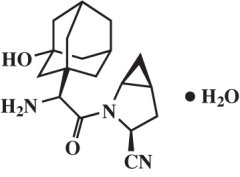
Saxagliptin is an orally-active inhibitor of the DPP4 enzyme. Saxagliptin monohydrate is described chemically as (1 S ,3 S ,5 S )-2-[(2 S )-2-Amino-2-(3-hydroxytricyclo[3.3.1.1 3,7 ]dec-1-yl)acetyl]-2-azabicyclo[3.1.0]hexane-3-carbonitrile, monohydrate or (1 S ,3 S ,5 S )-2-[(2 S )-2-Amino-2-(3-hydroxyadamantan-1-yl)acetyl]-2-azabicyclo[3.1.0]hexane-3-carbonitrile hydrate. The empirical formula is C 18 H 25 N 3 O 2 *H 2 O and the molecular weight is 333.43. The structural formula is: Saxagliptin monohydrate is a white to light yellow or light brown, non-hygroscopic, crystalline powder. It is sparingly soluble in water at 24°C ± 3°C, slightly soluble in ethyl acetate, and soluble in methanol, ethanol, isopropyl alcohol, acetonitrile, acetone, and polyethylene glycol 400 (PEG 400). Each film-coated tablet of ONGLYZA for oral use contains either 2.79 mg saxagliptin hydrochloride (anhydrous) equivalent to 2.5 mg saxagliptin or 5.58 mg saxagliptin hydrochloride (anhydrous) equivalent to 5 mg saxagliptin and the following inactive ingredients: lactose monohydrate, microcrystalline cellulose, croscarmellose sodium, and magnesium stearate. In addition, the film coating contains the following inactive ingredients: polyvinyl alcohol, polyethylene glycol, titanium dioxide, talc, and iron oxides. Saxagliptin Chemical Structure
ONGLYZA is a dipeptidyl peptidase-4 (DPP4) inhibitor indicated as an adjunct to diet and exercise to improve glycemic control in adults with type 2 diabetes mellitus in multiple clinical settings. (1.1 , 14) Important limitations of use: Should not be used for the treatment of type 1 diabetes mellitus or diabetic ketoacidosis. (1.2) Has not been studied in patients with a history of pancreatitis. (1.2, 5.1) 1.1 Monotherapy and Combination Therapy ONGLYZA is indicated as an adjunct to diet and exercise to improve glycemic control in adults with type 2 diabetes mellitus in multiple clinical settings. [See Clinical Studies (14) .] 1.2 Important Limitations of Use ONGLYZA should not be used for the treatment of type 1 diabetes mellitus or diabetic ketoacidosis, as it would not be effective in these settings. ONGLYZA has not been studied in patients with a history of pancreatitis. It is unknown whether patients with a history of pancreatitis are at an increased risk for the development of pancreatitis while using ONGLYZA. [See Warnings and Precautions (5.1) .]
The recommended dose is 2.5 mg or 5 mg once daily taken regardless of meals. (2.1) 2.5 mg daily is recommended for patients with moderate or severe renal impairment, or end-stage renal disease (CrCl ?50 mL/min). Assess renal function before starting ONGLYZA and periodically thereafter. (2.2) 2.5 mg daily is recommended for patients also taking strong cytochrome P450 3A4/5 (CYP3A4/5) inhibitors (e.g., ketoconazole). (2.3 , 7.1) 2.1 Recommended Dosing The recommended dose of ONGLYZA is 2.5 mg or 5 mg once daily taken regardless of meals. ONGLYZA tablets must not be split or cut. 2.2 Patients with Renal Impairment No dosage adjustment for ONGLYZA is recommended for patients with mild renal impairment (creatinine clearance [CrCl] >50 mL/min). The dose of ONGLYZA is 2.5 mg once daily for patients with moderate or severe renal impairment, or with end-stage renal disease (ESRD) requiring hemodialysis (creatinine clearance [CrCl] ?50 mL/min) [see Clinical Pharmacology (12.3) and Clinical Studies (14.3) ]. ONGLYZA should be administered following hemodialysis. ONGLYZA has not been studied in patients undergoing peritoneal dialysis. Because the dose of ONGLYZA should be limited to 2.5 mg based upon renal function, assessment of renal function is recommended prior to initiation of ONGLYZA and periodically thereafter. Renal function can be estimated from serum creatinine using the Cockcroft-Gault formula or Modification of Diet in Renal Disease formula. [See Clinical Pharmacology (12.3) .] 2.3 Strong CYP3A4/5 Inhibitors The dose of ONGLYZA is 2.5 mg once daily when coadministered with strong cytochrome P450 3A4/5 (CYP3A4/5) inhibitors (e.g., ketoconazole, atazanavir, clarithromycin, indinavir, itraconazole, nefazodone, nelfinavir, ritonavir, saquinavir, and telithromycin). [See Drug Interactions (7.1) and Clinical Pharmacology (12.3) .] 2.4 Concomitant Use with an Insulin Secretagogue (e.g., Sulfonylurea) or with Insulin When ONGLYZA is used in combination with an insulin secretagogue (e.g., sulfonylurea) or with insulin, a lower dose of the insulin secretagogue or insulin may be required to minimize the risk of hypoglycemia. [See Warnings and Precautions (5.1) .]
History of a serious hypersensitivity reaction to ONGLYZA, such as anaphylaxis, angioedema, or exfoliative skin conditions. [See Warnings and Precautions (5.3) and Adverse Reactions (6.2) .] History of a serious hypersensitivity reaction (e.g., anaphylaxis, angioedema, exfoliative skin conditions) to ONGLYZA. (4)
Adverse reactions reported in ?5% of patients treated with ONGLYZA and more commonly than in patients treated with placebo are: upper respiratory tract infection, urinary tract infection, and headache. (6.1) Peripheral edema was reported more commonly in patients treated with the combination of ONGLYZA and a thiazolidinedione (TZD) than in patients treated with the combination of placebo and TZD. (6.1) In the add-on to sulfonylurea and add-on to insulin trials, confirmed hypoglycemia was reported more commonly in patients treated with ONGLYZA compared to placebo. (6.1) Hypersensitivity-related events (e.g., urticaria, facial edema) were reported more commonly in patients treated with ONGLYZA than in patients treated with placebo. (6.1) To report SUSPECTED ADVERSE REACTIONS, contact Bristol-Myers Squibb at 1-800-721-5072 or FDA at 1-800-FDA-1088 or www.fda.gov/medwatch 6.1 Clinical Trials Experience Because clinical trials are conducted under widely varying conditions, adverse reaction rates observed in the clinical trials of a drug cannot be directly compared to rates in the clinical trials of another drug and may not reflect the rates observed in practice. Monotherapy and Add-On Combination Therapy In two placebo-controlled monotherapy trials of 24-weeks duration, patients were treated with ONGLYZA 2.5 mg daily, ONGLYZA 5 mg daily, and placebo. Three 24-week, placebo-controlled, add-on combination therapy trials were also conducted: one with metformin, one with a thiazolidinedione (pioglitazone or rosiglitazone), and one with glyburide. In these three trials, patients were randomized to add-on therapy with ONGLYZA 2.5 mg daily, ONGLYZA 5 mg daily, or placebo. A saxagliptin 10 mg treatment arm was included in one of the monotherapy trials and in the add-on combination trial with metformin. In a prespecified pooled analysis of the 24-week data (regardless of glycemic rescue) from the two monotherapy trials, the add-on to metformin trial, the add-on to thiazolidinedione (TZD) trial, and the add-on to glyburide trial, the overall incidence of adverse events in patients treated with ONGLYZA 2.5 mg and ONGLYZA 5 mg was similar to placebo (72.0% and 72.2% versus 70.6%, respectively). Discontinuation of therapy due to adverse events occurred in 2.2%, 3.3%, and 1.8% of patients receiving ONGLYZA 2.5 mg, ONGLYZA 5 mg, and placebo, respectively. The most common adverse events (reported in at least 2 patients treated with ONGLYZA 2.5 mg or at least 2 patients treated with ONGLYZA 5 mg) associated with premature discontinuation of therapy included lymphopenia (0.1% and 0.5% versus 0%, respectively), rash (0.2% and 0.3% versus 0.3%), blood creatinine increased (0.3% and 0% versus 0%), and blood creatine phosphokinase increased (0.1% and 0.2% versus 0%). The adverse reactions in this pooled analysis reported (regardless of investigator assessment of causality) in ?5% of patients treated with ONGLYZA 5 mg, and more commonly than in patients treated with placebo are shown in Table 1. Table 1: Adverse Reactions (Regardless of Investigator Assessment of Causality) in Placebo-Controlled Trials* Reported in ?5% of Patients Treated with ONGLYZA 5 mg and More Commonly than in Patients Treated with Placebo Number (%) of Patients ONGLYZA 5 mg N=882 Placebo N=799 * The 5 placebo-controlled trials include two monotherapy trials and one add-on combination therapy trial with each of the following: metformin, thiazolidinedione, or glyburide. Table shows 24-week data regardless of glycemic rescue. Upper respiratory tract infection 68 (7.7) 61 (7.6) Urinary tract infection 60 (6.8) 49 (6.1) Headache 57 (6.5) 47 (5.9) In patients treated with ONGLYZA 2.5 mg, headache (6.5%) was the only adverse reaction reported at a rate ?5% and more commonly than in patients treated with placebo. In this pooled analysis, adverse reactions that were reported in ?2% of patients treated with ONGLYZA 2.5 mg or ONGLYZA 5 mg and ?1% more frequently compared to placebo included: sinusitis (2.9% and 2.6% versus 1.6%, respectively), abdominal pain (2.4% and 1.7% versus 0.5%), gastroenteritis (1.9% and 2.3% versus 0.9%), and vomiting (2.2% and 2.3% versus 1.3%). In the add-on to TZD trial, the incidence of peripheral edema was higher for ONGLYZA 5 mg versus placebo (8.1% and 4.3%, respectively). The incidence of peripheral edema for ONGLYZA 2.5 mg was 3.1%. None of the reported adverse reactions of peripheral edema resulted in study drug discontinuation. Rates of peripheral edema for ONGLYZA 2.5 mg and ONGLYZA 5 mg versus placebo were 3.6% and 2% versus 3% given as monotherapy, 2.1% and 2.1% versus 2.2% given as add-on therapy to metformin, and 2.4% and 1.2% versus 2.2% given as add-on therapy to glyburide. The incidence rate of fractures was 1.0 and 0.6 per 100 patient-years, respectively, for ONGLYZA (pooled analysis of 2.5 mg, 5 mg, and 10 mg) and placebo. The incidence rate of fracture events in patients who received ONGLYZA did not increase over time. Causality has not been established and nonclinical studies have not demonstrated adverse effects of saxagliptin on bone. An event of thrombocytopenia, consistent with a diagnosis of idiopathic thrombocytopenic purpura, was observed in the clinical program. The relationship of this event to ONGLYZA is not known. Use in Renal Impairment ONGLYZA 2.5 mg was compared to placebo in a 12-week trial in 170 patients with type 2 diabetes and moderate or severe renal impairment or end-stage renal disease (ESRD). The incidence of adverse events, including serious adverse events and discontinuations due to adverse events, was similar between ONGLYZA and placebo. Use in Combination with Insulin In the add-on to insulin trial [see Clinical Studies (14.2) ], the incidence of adverse events, including serious adverse events and discontinuations due to adverse events, was similar between ONGLYZA and placebo, except for confirmed hypoglycemia (see Hypoglycemia subsection). Adverse Reactions Associated with ONGLYZA Coadministered with Metformin in Treatment-Naive Patients with Type 2 Diabetes Table 2 shows the adverse reactions reported (regardless of investigator assessment of causality) in ?5% of patients participating in an additional 24-week, active-controlled trial of coadministered ONGLYZA and metformin in treatment-naive patients. Table 2: Initial Therapy with Combination of ONGLYZA and Metformin in Treatment-Naive Patients: Adverse Reactions Reported (Regardless of Investigator Assessment of Causality) in ?5% of Patients Treated with Combination Therapy of ONGLYZA 5 mg Plus Metformin (and More Commonly than in Patients Treated with Metformin Alone) Number (%) of Patients ONGLYZA 5 mg + Metformin* N=320 Metformin* N=328 * Metformin was initiated at a starting dose of 500 mg daily and titrated up to a maximum of 2000 mg daily. Headache 24 (7.5) 17 (5.2) Nasopharyngitis 22 (6.9) 13 (4.0) Hypoglycemia Adverse reactions of hypoglycemia were based on all reports of hypoglycemia. A concurrent glucose measurement was not required or was normal in some patients. Therefore, it is not possible to conclusively determine that all these reports reflect true hypoglycemia. In the add-on to glyburide study, the overall incidence of reported hypoglycemia was higher for ONGLYZA 2.5 mg and ONGLYZA 5 mg (13.3% and 14.6%) versus placebo (10.1%). The incidence of confirmed hypoglycemia in this study, defined as symptoms of hypoglycemia accompanied by a fingerstick glucose value of ?50 mg/dL, was 2.4% and 0.8% for ONGLYZA 2.5 mg and ONGLYZA 5 mg and 0.7% for placebo [see Warnings and Precautions (5.2) ]. The incidence of reported hypoglycemia for ONGLYZA 2.5 mg and ONGLYZA 5 mg versus placebo given as monotherapy was 4.0% and 5.6% versus 4.1%, respectively, 7.8% and 5.8% versus 5% given as add-on therapy to metformin, and 4.1% and 2.7% versus 3.8% given as add-on therapy to TZD. The incidence of reported hypoglycemia was 3.4% in treatment-naive patients given ONGLYZA 5 mg plus metformin and 4.0% in patients given metformin alone. In the active-controlled trial comparing add-on therapy with ONGLYZA 5 mg to glipizide in patients inadequately controlled on metformin alone, the incidence of reported hypoglycemia was 3% (19 events in 13 patients) with ONGLYZA 5 mg versus 36.3% (750 events in 156 patients) with glipizide. Confirmed symptomatic hypoglycemia (accompanying fingerstick blood glucose ?50 mg/dL) was reported in none of the ONGLYZA-treated patients and in 35 glipizide-treated patients (8.1%) (p<0.0001). During 12 weeks of treatment in patients with moderate or severe renal impairment or ESRD, the overall incidence of reported hypoglycemia was 20% among patients treated with ONGLYZA 2.5 mg and 22% among patients treated with placebo. Four ONGLYZA-treated patients (4.7%) and three placebo-treated patients (3.5%) reported at least one episode of confirmed symptomatic hypoglycemia (accompanying fingerstick glucose ?50 mg/dL). In the add-on to insulin trial, the overall incidence of reported hypoglycemia was 18.4% for ONGLYZA 5 mg and 19.9% for placebo. However, the incidence of confirmed symptomatic hypoglycemia (accompanying fingerstick blood glucose ?50 mg/dL) was higher with ONGLYZA 5 mg (5.3%) versus placebo (3.3%) [see Warnings and Precautions (5.2) ]. Hypersensitivity Reactions Hypersensitivity-related events, such as urticaria and facial edema in the 5-study pooled analysis up to Week 24 were reported in 1.5%, 1.5%, and 0.4% of patients who received ONGLYZA 2.5 mg, ONGLYZA 5 mg, and placebo, respectively. None of these events in patients who received ONGLYZA required hospitalization or were reported as life-threatening by the investigators. One saxagliptin-treated patient in this pooled analysis discontinued due to generalized urticaria and facial edema. Infections In the unblinded, controlled, clinical trial database for saxagliptin to date, there have been 6 (0.12%) reports of tuberculosis among the 4959 saxagliptin-treated patients (1.1 per 1000 patient-years) compared to no reports of tuberculosis among the 2868 comparator-treated patients. Two of these six cases were confirmed with laboratory testing. The remaining cases had limited information or had presumptive diagnoses of tuberculosis. None of the six cases occurred in the United States or in Western Europe. One case occurred in Canada in a patient originally from Indonesia who had recently visited Indonesia. The duration of treatment with saxagliptin until report of tuberculosis ranged from 144 to 929 days. Post-treatment lymphocyte counts were consistently within the reference range for four cases. One patient had lymphopenia prior to initiation of saxagliptin that remained stable throughout saxagliptin treatment. The final patient had an isolated lymphocyte count below normal approximately four months prior to the report of tuberculosis. There have been no spontaneous reports of tuberculosis associated with saxagliptin use. Causality has not been estimated and there are too few cases to date to determine whether tuberculosis is related to saxagliptin use. There has been one case of a potential opportunistic infection in the unblinded, controlled clinical trial database to date in a saxagliptin-treated patient who developed suspected foodborne fatal salmonella sepsis after approximately 600 days of saxagliptin therapy. There have been no spontaneous reports of opportunistic infections associated with saxagliptin use. Vital Signs No clinically meaningful changes in vital signs have been observed in patients treated with ONGLYZA. Laboratory Tests Absolute Lymphocyte Counts There was a dose-related mean decrease in absolute lymphocyte count observed with ONGLYZA. From a baseline mean absolute lymphocyte count of approximately 2200 cells/microL, mean decreases of approximately 100 and 120 cells/microL with ONGLYZA 5 mg and 10 mg, respectively, relative to placebo were observed at 24 weeks in a pooled analysis of five placebo-controlled clinical studies. Similar effects were observed when ONGLYZA 5 mg was given in initial combination with metformin compared to metformin alone. There was no difference observed for ONGLYZA 2.5 mg relative to placebo. The proportion of patients who were reported to have a lymphocyte count ?750 cells/microL was 0.5%, 1.5%, 1.4%, and 0.4% in the saxagliptin 2.5 mg, 5 mg, 10 mg, and placebo groups, respectively. In most patients, recurrence was not observed with repeated exposure to ONGLYZA although some patients had recurrent decreases upon rechallenge that led to discontinuation of ONGLYZA. The decreases in lymphocyte count were not associated with clinically relevant adverse reactions. The clinical significance of this decrease in lymphocyte count relative to placebo is not known. When clinically indicated, such as in settings of unusual or prolonged infection, lymphocyte count should be measured. The effect of ONGLYZA on lymphocyte counts in patients with lymphocyte abnormalities (e.g., human immunodeficiency virus) is unknown. Platelets ONGLYZA did not demonstrate a clinically meaningful or consistent effect on platelet count in the six, double-blind, controlled clinical safety and efficacy trials. 6.2 Postmarketing Experience Additional adverse reactions have been identified during postapproval use of ONGLYZA. Because these reactions are reported voluntarily from a population of uncertain size, it is generally not possible to reliably estimate their frequency or establish a causal relationship to drug exposure. Hypersensitivity reactions including anaphylaxis, angioedema, and exfoliative skin conditions. [See Contraindications (4) and Warnings and Precautions (5.3) .] Acute pancreatitis. [See Indications and Usage (1.2) and Warnings and Precautions (5.1) .]
There have been postmarketing reports of acute pancreatitis. If pancreatitis is suspected, promptly discontinue ONGLYZA. (5.1) When used with an insulin secretagogue (e.g., sulfonylurea) or insulin, a lower dose of the insulin secretagogue or insulin may be required to minimize the risk of hypoglycemia. (5.2) There have been postmarketing reports of serious hypersensitivity reactions in patients treated with ONGLYZA such as anaphylaxis, angioedema, and exfoliative skin conditions. In such cases, promptly discontinue ONGLYZA, assess for other potential causes, institute appropriate monitoring and treatment, and initiate alternative treatment for diabetes. (5.3 , 6.2) There have been no clinical studies establishing conclusive evidence of macrovascular risk reduction with ONGLYZA or any other antidiabetic drug. (5.4) 5.1 Pancreatitis There have been postmarketing reports of acute pancreatitis in patients taking ONGLYZA. After initiation of ONGLYZA, patients should be observed carefully for signs and symptoms of pancreatitis. If pancreatitis is suspected, ONGLYZA should promptly be discontinued and appropriate management should be initiated. It is unknown whether patients with a history of pancreatitis are at increased risk for the development of pancreatitis while using ONGLYZA. 5.2 Use with Medications Known to Cause Hypoglycemia When ONGLYZA was used in combination with a sulfonylurea or with insulin, medications known to cause hypoglycemia, the incidence of confirmed hypoglycemia was increased over that of placebo used in combination with a sulfonylurea or with insulin. [See Adverse Reactions (6.1) .] Therefore, a lower dose of the insulin secretagogue or insulin may be required to minimize the risk of hypoglycemia when used in combination with ONGLYZA. [See Dosage and Administration (2.4) .] 5.3 Hypersensitivity Reactions There have been postmarketing reports of serious hypersensitivity reactions in patients treated with ONGLYZA. These reactions include anaphylaxis, angioedema, and exfoliative skin conditions. Onset of these reactions occurred within the first 3 months after initiation of treatment with ONGLYZA, with some reports occurring after the first dose. If a serious hypersensitivity reaction is suspected, discontinue ONGLYZA, assess for other potential causes for the event, and institute alternative treatment for diabetes. [See Adverse Reactions (6.2) .] Use caution in a patient with a history of angioedema to another dipeptidyl peptidase-4 (DPP4) inhibitor because it is unknown whether such patients will be predisposed to angioedema with ONGLYZA. 5.4 Macrovascular Outcomes There have been no clinical studies establishing conclusive evidence of macrovascular risk reduction with ONGLYZA or any other antidiabetic drug.
Coadministration with strong CYP3A4/5 inhibitors (e.g., ketoconazole) significantly increases saxagliptin concentrations. Recommend limiting ONGLYZA dose to 2.5 mg once daily. (2.3 , 7.1) 7.1 Strong Inhibitors of CYP3A4/5 Enzymes Ketoconazole significantly increased saxagliptin exposure. Similar significant increases in plasma concentrations of saxagliptin are anticipated with other strong CYP3A4/5 inhibitors (e.g., atazanavir, clarithromycin, indinavir, itraconazole, nefazodone, nelfinavir, ritonavir, saquinavir, and telithromycin). The dose of ONGLYZA should be limited to 2.5 mg when coadministered with a strong CYP3A4/5 inhibitor. [See Dosage and Administration (2.3) and Clinical Pharmacology (12.3) .]