
İHALE DÜNYASI
İHALE DÜNYASI
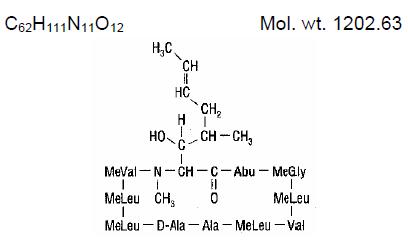
Cyclosporine, the active principle in Cyclosporine Capsules, USP is a cyclic polypeptide immunosuppressant agent consisting of 11 amino acids. It is produced as a metabolite by the fungus species Tolypocladium inflatum Gams . Chemically, cyclosporine is designated as [ R -[ R *, R *-( E )]]-cyclic(L-alanyl-D-alanyl- N -methyl-L-leucyl- N -methyl-L-leucyl- N -methyl-L-valyl-3-hydroxy- N ,4-dimethyl-L-2-amino-6-octenoyl-L-?-amino-butyryl- N -methylglycyl- N -methyl-L-leucyl-L-valyl- N -methyl-L-leucyl). Cyclosporine Capsules, USP are available in 25 mg and 100 mg strengths. Each 25 mg capsule contains: cyclosporine, USP.................................................................................25 mg Each 100 mg capsule contains: cyclosporine, USP................................................................................100 mg Each capsule contains the following inactive ingredients: methanol, purified water, sodium lauryl sulfate and talc. The 25 mg and the 100 mg capsule shell contains gelatin, red iron oxide and titanium dioxide. The 25 mg and 100 mg capsule black imprinting ink contains the following inactive ingredients: n-butyl alcohol, D&C yellow #10 aluminum lake, FD&C blue #1 aluminum lake, FD&C blue #2 aluminum lake, FD&C red #40 aluminum lake, pharmaceutical glaze, propylene glycol, SDA-3A alcohol and synthetic black iron oxide. The chemical structure of cyclosporine (also known as cyclosporin A) is: structure
Cyclosporine Capsules, USP are indicated for the prophylaxis of organ rejection in kidney, liver, and heart allogeneic transplants. It is always to be used with adrenal corticosteroids. The drug may also be used in the treatment of chronic rejection in patients previously treated with other immunosuppressive agents.
Cyclosporine Capsules, USP NON-MODIFIED Cyclosporine Capsules, USP (NON-MODIFIED) have decreased bioavailability in comparison to Neoral (R) * (cyclosporine capsules, USP) MODIFIED. Cyclosporine Capsules, USP (NON-MODIFIED) and Neoral (R) * (cyclosporine capsules, USP) MODIFIED are not bioequivalent and cannot be used interchangeably without physician supervision. The initial oral dose of Cyclosporine Capsules, USP NON-MODIFIED should be given 4 to 12 hours prior to transplantation as a single dose of 15 mg/kg. Although a daily single dose of 14 to 18 mg/kg was used in most clinical trials, few centers continue to use the highest dose, most favoring the lower end of the scale. There is a trend towards use of even lower initial doses for renal transplantation in the ranges of 10 to 14 mg/kg/day. The initial single daily dose is continued postoperatively for 1 to 2 weeks and then tapered by 5% per week to a maintenance dose of 5 to 10 mg/kg/day. Some centers have successfully tapered the maintenance dose to as low as 3 mg/kg/day in selected renal transplant patients without an apparent rise in rejection rate. (See Blood Level Monitoring below.) In pediatric usage, the same dose and dosing regimen may be used as in adults although in several studies, children have required and tolerated higher doses than those used in adults. Adjunct therapy with adrenal corticosteroids is recommended. Different tapering dosage schedules of prednisone appear to achieve similar results. A dosage schedule based on the patient's weight started with 2.0 mg/kg/day for the first 4 days tapered to 1.0 mg/kg/day by 1 week, 0.6 mg/kg/day by 2 weeks, 0.3 mg/kg/day by 1 month, and 0.15 mg/kg/day by 2 months and thereafter as a maintenance dose. Another center started with an initial dose of 200 mg tapered by 40 mg/day until reaching 20 mg/day. After 2 months at this dose, a further reduction to 10 mg/day was made. Adjustments in dosage of prednisone must be made according to the clinical situation. Cyclosporine Capsules, USP NON-MODIFIED should be administered on a consistent schedule with regard to time of day and relation to meals. Blood Level Monitoring Several study centers have found blood level monitoring of cyclosporine useful in patient management. While no fixed relationships have yet been established, in one series of 375 consecutive cadaveric renal transplant recipients, dosage was adjusted to achieve specific whole blood 24-hour trough levels of 100 to 200 ng/mL as determined by high-pressure liquid chromatography (HPLC). Of major importance to blood level analysis is the type of assay used. The above levels are specific to the parent cyclosporine molecule and correlate directly to the new monoclonal specific radioimmunoassays (mRIA-sp). Nonspecific assays are also available which detect the parent compound molecule and various of its metabolites. Older studies often cited levels using a nonspecific assay which were roughly twice those of specific assays. Assay results are not interchangeable and their use should be guided by their approved labeling. If plasma specimens are employed, levels will vary with the temperature at the time of separation from whole blood. Plasma levels may range from 1/2 to 1/5 of whole blood levels. Refer to individual assay labeling for complete instructions. In addition, Transplantation Proceedings (June 1990) contains position papers and a broad consensus generated at the Cyclosporine-Therapeutic Drug Monitoring conference that year. Blood level monitoring is not a replacement for renal function monitoring or tissue biopsies.
Cyclosporine capsules are contraindicated in patients with a hypersensitivity to cyclosporine or to any of the ingredients of the formulation.
The principal adverse reactions of cyclosporine therapy are renal dysfunction, tremor, hirsutism, hypertension, and gum hyperplasia. Hypertension, which is usually mild to moderate, may occur in approximately 50% of patients following renal transplantation and in most cardiac transplant patients. Glomerular capillary thrombosis has been found in patients treated with cyclosporine and may progress to graft failure. The pathologic changes resemble those seen in the hemolytic-uremic syndrome and include thrombosis of the renal microvasculature, with platelet-fibrin thrombi occluding glomerular capillaries and afferent arterioles, microangiopathic hemolytic anemia, thrombocytopenia, and decreased renal function. Similar findings have been observed when other immunosuppressives have been employed posttransplantation. Hypomagnesemia has been reported in some, but not all, patients exhibiting convulsions while on cyclosporine therapy. Although magnesium-depletion studies in normal subjects suggest that hypomagnesemia is associated with neurologic disorders, multiple factors, including hypertension, high-dose methylprednisolone, hypocholesterolemia, and nephrotoxicity associated with high plasma concentrations of cyclosporine appear to be related to the neurological manifestations of cyclosporine toxicity. The following reactions occurred in 3% or greater of 892 patients involved in clinical trials of kidney, heart, and liver transplants: Randomized Kidney Patients All Cyclosporine Patients Cyclosporine Azathioprine Kidney Heart Liver Body System/ (N=227) (N=228) (N=705) (N=112) (N=75) Adverse Reactions % % % % % Genitourinary Renal Dysfunction 32 6 25 38 37 Cardiovascular Hypertension 26 18 13 53 27 Cramps 4 < 1 2 < 1 0 Skin Hirsutism 21 < 1 21 28 45 Acne 6 8 2 2 1 Central Nervous System Tremor 12 0 21 31 55 Convulsions 3 1 1 4 5 Headache 2 < 1 2 15 4 Gastrointestinal Gum Hyperplasia 4 0 9 5 16 Diarrhea 3 < 1 3 4 8 Nausea/Vomiting 2 < 1 4 10 4 Hepatotoxicity < 1 < 1 4 7 4 Abdominal Discomfort < 1 0 < 1 7 0 Autonomic Nervous System Paresthesia 3 0 1 2 1 Flushing < 1 0 4 0 4 Hematopoietic Leukopenia 2 19 < 1 6 0 Lymphoma < 1 0 1 6 1 Respiratory Sinusitis < 1 0 4 3 7 Miscellaneous Gynecomastia < 1 0 < 1 4 3 The following reactions occurred in 2% or less of patients: allergic reactions, anemia, anorexia, confusion, conjunctivitis, edema, fever, brittle fingernails, gastritis, hearing loss, hiccups, hyperglycemia, muscle pain, peptic ulcer, thrombocytopenia, tinnitus. The following reactions occurred rarely: anxiety, chest pain, constipation, depression, hair breaking, hematuria, joint pain, lethargy, mouth sores, myocardial infarction, night sweats, pancreatitis, pruritus, swallowing difficulty, tingling, upper GI bleeding, visual disturbance, weakness, weight loss. Renal Transplant Patients in Whom Therapy Was Discontinued Randomized Patients All Cyclosporine Patients Cyclosporine Azathioprine (N=227) (N=228) (N=705) Reason for Discontinuation % % % Renal Toxicity 5.7 0 5.4 Infection 0 0.4 0.9 Lack of Efficacy 2.6 0.9 1.4 Acute Tubular Necrosis 2.6 0 1.0 Lymphoma/Lymphoproliferative Disease 0.4 0 0.3 Hypertension 0 0 0.3 Hematological Abnormalities 0 0.4 0 Other 0 0 0.7 Cyclosporine was discontinued on a temporary basis and then restarted in 18 additional patients . Patients receiving immunosuppressive therapies, including cyclosporine and cyclosporine -containing regimens, are at increased risk of infections (viral, bacterial, fungal, parasitic). Both generalized and localized infections can occur. Pre-existing infections may also be aggravated. Fatal outcomes have been reported (see WARNINGS ). Infectious Complications in the Randomized Renal Transplant Patients Cyclosporine Treatment Standard Treatment Some patients also received ALG. (N=227) (N=228) Complication % of Complications % of Complications Septicemia 5.3 4.8 Abscesses 4.4 5.3 Systemic Fungal Infection 2.2 3.9 Local Fungal Infection 7.5 9.6 Cytomegalovirus 4.8 12.3 Other Viral Infections 15.9 18.4 Urinary Tract Infections 21.1 20.2 Wound and Skin Infections 7.0 10.1 Pneumonia 6.2 9.2 Postmarketing Experience BK virus associated nephropathy has been observed in patients receiving immunosuppressants, including cyclosporine. This infection is associated with serious outcomes, including deteriorating renal function and renal graft loss (see WARNINGS ).
(See boxed WARNINGS . ) Cyclosporine Capsules, USP NON-MODIFIED, when used in high doses, can cause hepatotoxicity and nephrotoxicity. It is not unusual for serum creatinine and BUN levels to be elevated during cyclosporine therapy. These elevations in renal transplant patients do not necessarily indicate rejection, and each patient must be fully evaluated before dosage adjustment is initiated. Nephrotoxicity has been noted in 25% of cases of renal transplantation, 38% of cases of cardiac transplantation, and 37% of cases of liver transplantation. Mild nephrotoxicity was generally noted 2 to 3 months after transplant and consisted of an arrest in the fall of the preoperative elevations of BUN and creatinine at a range of 35 to 45 mg/dl and 2.0 to 2.5 mg/dl, respectively. These elevations were often responsive to dosage reduction. More overt nephrotoxicity was seen early after transplantation and was characterized by a rapidly rising BUN and creatinine. Since these events are similar to rejection episodes, care must be taken to differentiate between them. This form of nephrotoxicity is usually responsive to cyclosporine dosage reduction. Although specific diagnostic criteria which reliably differentiate renal graft rejection from drug toxicity have not been found, a number of parameters have been significantly associated to one or the other. It should be noted however, that up to 20% of patients may have simultaneous nephrotoxicity and rejection. Nephrotoxicity vs. Rejection Parameter Nephrotoxicity Rejection History Donor > 50 years old or hypotensive Antidonor immune response Prolonged kidney preservation Retransplant patient Prolonged anastomosis time Concomitant nephrotoxic drugs Clinical Often > 6 weeks postop b Often < 4 weeks postop b Prolonged initial nonfunction Fever > 37.5°C (acute tubular necrosis) Weight gain > 0.5 kg Graft swelling and tenderness Decrease in daily urine volume > 500 mL (or 50%) Laboratory CyA serum trough level > 200 ng/mL CyA serum trough level < 150 ng/mL Gradual rise in Cr (< 0.15 mg/dl/day) a Rapid rise in Cr (> 0.3 mg/dl/day) a Cr plateau < 25% above baseline Cr > 25% above baseline BUN/Cr ? 20 BUN/Cr < 20 Biopsy Arteriolopathy (medial hypertrophy a , Endovasculitis c (proliferation a , hyalinosis, nodular deposits, intimal intimal arteritis b , necrosis, sclerosis) thickening, endothelial vacuolization, progressive scarring) Tubular atrophy, isometric vacuolization, Tubulitis with RBC b and WBC b casts, isolated calcifications some irregular vacuolization Minimal edema Interstitial edema c and hemorrhage b Mild focal infiltrates c Diffuse moderate to severe mononuclear infiltrates d Diffuse interstitial fibrosis, Glomerulitis (mononuclear cells) c often striped form Aspiration Cytology CyA deposits in tubular and Inflammatory infiltrate with mononuclear phagocytes, endothelial cells macrophages, lymphoblastoid cells, and activated T-cells Fine isometric vacuolization of tubular cells These strongly express HLA-DR antigens Urine Cytology Tubular cells with vacuolization and Degenerative tubular cells, plasma cells, and granularization lymphocyturia > 20% of sediment Manometry Intracapsular pressure < 40 mm Hg b Intracapsular pressure > 40 mm Hg b Ultrasonography Unchanged graft cross-sectional area Increase in graft cross-sectional area AP diameter ? Transverse diameter Magnetic Resonance Normal appearance Loss of distinct corticomedullary junction, swelling, Imagery image intensity of parachyma approaching that of psoas, loss of hilar fat Radionuclide Scan Normal or generally decreased perfusion Patchy arterial flow Decrease in tubular function Decrease in perfusion > decrease in tubular function ( 131 I-hippuran) > decrease in perfusion Increased uptake of Indium 111 labeled platelets or ( 99m Tc DTPA) Tc-99m in colloid Therapy Responds to decreased Sandimmune (R) Responds to increased steroids or (cyclosporine) antilymphocyte globulin a p < 0.05, b p < 0.01, c p < 0.001, d p < 0.0001 A form of chronic progressive cyclosporine-associated nephrotoxicity is characterized by serial deterioration in renal function and morphologic changes in the kidneys. From 5% to 15% of transplant recipients will fail to show a reduction in a rising serum creatinine despite a decrease or discontinuation of cyclosporine therapy. Renal biopsies from these patients will demonstrate an interstitial fibrosis with tubular atrophy. In addition, toxic tubulopathy, peritubular capillary congestion, arteriolopathy, and a striped form of interstitial fibrosis with tubular atrophy may be present. Though none of these morphologic changes is entirely specific, a histologic diagnosis of chronic progressive cyclosporine-associated nephrotoxicity requires evidence of these. When considering the development of chronic nephrotoxicity it is noteworthy that several authors have reported an association between the appearance of interstitial fibrosis and higher cumulative doses or persistently high circulating trough levels of cyclosporine. This is particularly true during the first 6 posttransplant months when the dosage tends to be highest and when, in kidney recipients, the organ appears to be most vulnerable to the toxic effects of cyclosporine. Among other contributing factors to the development of interstitial fibrosis in these patients must be included, prolonged perfusion time, warm ischemia time, as well as episodes of acute toxicity, and acute and chronic rejection. The reversibility of interstitial fibrosis and its correlation to renal function have not yet been determined. Impaired renal function at any time requires close monitoring, and frequent dosage adjustment may be indicated. In patients with persistent high elevations of BUN and creatinine who are unresponsive to dosage adjustments, consideration should be given to switching to other immunosuppressive therapy. In the event of severe and unremitting rejection, it is preferable to allow the kidney transplant to be rejected and removed rather than increase the cyclosporine dosage to a very high level in an attempt to reverse the rejection. Occasionally patients have developed a syndrome of thrombocytopenia and microangiopathic hemolytic anemia which may result in graft failure. The vasculopathy can occur in the absence of rejection and is accompanied by avid platelet consumption within the graft as demonstrated by Indium 111 labeled platelet studies. Neither the pathogenesis nor the management of this syndrome is clear. Though resolution has occurred after reduction or discontinuation of cyclosporine and 1) administration of streptokinase and heparin or 2) plasmapheresis, this appears to depend upon early detection with Indium 111 labeled platelet scans (see ADVERSE REACTIONS ). Significant hyperkalemia (sometimes associated with hyperchloremic metabolic acidosis) and hyperuricemia have been seen occasionally in individual patients. Hepatotoxicity has been noted in 4% of cases of renal transplantation, 7% of cases of cardiac transplantation, and 4% of cases of liver transplantation. This was usually noted during the first month of therapy when high doses of cyclosporine were used and consisted of elevations of hepatic enzymes and bilirubin. The chemistry elevations usually decreased with a reduction in dosage. As in patients receiving other immunosuppressants, those patients receiving cyclosporine are at increased risk for development of lymphomas and other malignancies, particularly those of the skin. The increased risk appears related to the intensity and duration of immunosuppression rather than to the use of specific agents. Because of the danger of oversuppression of the immune system, which can also increase susceptibility to infection, cyclosporine should not be administered with other immunosuppressive agents except adrenal corticosteroids. The efficacy and safety of cyclosporine in combination with other immunosuppressive agents have not been determined. Some malignancies may be fatal. Transplant patients receiving cyclosporine are at increased risk for serious infection with fatal outcome. Latent Viral Infections Immunosuppressed patients are at increased risk for opportunistic infections, including activation of latent viral infections. These include BK virus-associated nephropathy which has been observed in patients receiving immunosuppressants, including cyclosporine. This infection is associated with serious outcomes, including deteriorating renal function and renal graft loss. Patient monitoring may help detect patients at risk for BK virus-associated nephropathy. Reduction in immunosuppression should be considered for patients who develop evidence of BK virus-associated nephropathy. There have been reports of convulsions in adult and pediatric patients receiving cyclosporine, particularly in combination with high-dose methylprednisolone. Encephalopathy has been described both in postmarketing reports and in the literature. Manifestations include impaired consciousness, convulsions, visual disturbances (including blindness), loss of motor function, movement disorders and psychiatric disturbances. In many cases, changes in the white matter have been detected using imaging techniques and pathologic specimens. Predisposing factors such as hypertension, hypomagnesemia, hypocholesterolemia, high-dose corticosteroids, high cyclosporine blood concentrations, and graft-versus-host disease have been noted in many but not all of the reported cases. The changes in most cases have been reversible upon discontinuation of cyclosporine, and in some cases, improvement was noted after reduction of dose. It appears that patients receiving liver transplant are more susceptible to encephalopathy than those receiving kidney transplant. Another rare manifestation of cyclosporine-induced neurotoxicity is optic disc edema including papilloedema, with possible visual impairment, secondary to benign intracranial hypertension. Care should be taken in using cyclosporine with nephrotoxic drugs (see PRECAUTIONS ). Because Cyclosporine, Capsules, USP NON-MODIFIED is not bioequivalent to Neoral (R) *, conversion from Neoral (R) * to Cyclosporine Capsules, USP NON-MODIFIED using a 1:1 ratio (mg/kg/day) may result in a lower cyclosporine blood concentration. Conversion from Neoral (R) * to Cyclosporine Capsules, USP NON-MODIFIED should be made with increased blood concentration monitoring to avoid the potential of underdosing. --- BOXED WARNING: WARNING Only physicians experienced in immunosuppressive therapy and management of organ transplant patients should prescribe Cyclosporine Capsules, USP NON-MODIFIED. Patients receiving the drug should be managed in facilities equipped and staffed with adequate laboratory and supportive medical resources. The physician responsible for maintenance therapy should have complete information requisite for the follow-up of the patient. Cyclosporine Capsules, USP NON-MODIFIED should be administered with adrenal corticosteroids but not with other immunosuppressive agents. Increased susceptibility to infection and the possible development of lymphoma may result from immunosuppression. Cyclosporine Soft Gelatin Capsules, USP (NON-MODIFIED) have decreased bioavailability in comparison to Neoral (R) * (cyclosporine capsules, USP) MODIFIED. Cyclosporine Capsules, USP (NON-MODIFIED) and Neoral (R) * (cyclosporine capsules, USP) MODIFIED are not bioequivalent and cannot be used interchangeably without physician supervision. The absorption of cyclosporine during chronic administration of Cyclosporine Capsules, USP NON-MODIFIED was found to be erratic. It is recommended that patients taking Cyclosporine Capsules, USP NON-MODIFIED over a period of time be monitored at repeated intervals for cyclosporine blood levels and subsequent dose adjustments be made in order to avoid toxicity due to high levels and possible organ rejection due to low absorption of cyclosporine. This is of special importance in liver transplants. Numerous assays are being developed to measure blood levels of cyclosporine. Comparison of levels in published literature to patient levels using current assays must be done with detailed knowledge of the assay methods employed. (See Blood Level Monitoring under DOSAGE AND ADMINISTRATION .)
All of the individual drugs cited below are well substantiated to interact with cyclosporine. In addition, concomitant non-steroidal anti-inflammatory drugs, particularly in the setting of dehydration, may potentiate renal dysfunction. Drugs That May Potentiate Renal Dysfunction Antibiotics Antineoplastic Antifungals Anti- Inflammatory Drugs Gastrointestinal Agents Immunosuppressives Other Drugs ciprofloxacin gentamicin tobramycin trimethoprim with sulfamethoxazole vancomycin melphalan amphotericin B ketoconazole azapropazon colchicine diclofenac naproxen sulindac cimetidine ranitidine tacrolimus fibric acid derivatives (e.g., bezafibrate, fenofibrate) Drugs That Alter Cyclosporine Concentrations Cyclosporine is extensively metabolized by CYP 3A isoenzymes, in particular CYP3A4, and is a substrate of the multidrug efflux transporter P-glycoprotein. Various agents are known to either increase or decrease plasma or whole blood of cyclosporine levels usually by inhibition or induction of CYP3A4 or P-glycoprotein transporter or both. Compounds that decrease cyclosporine absorption such as orlistat should be avoided. Cyclosporine is extensively metabolized by cytochrome P-450 3A. Monitoring of circulating cyclosporine concentrations and appropriate cyclosporine dosage adjustment are essential when these drugs are used concomitantly (see Blood Level Monitoring ). Drugs That Increase Cyclosporine Concentrations Calcium Channel Blockers Antifungals Antibiotics Glucocorticoids Other Drugs diltiazem fluconazole azithromycin methylprednisolone allopurinol nicardipine itraconazole clarithromycin amiodarone verapamil ketoconazole erythromycin bromocriptine quinupristin/ colchicine voriconazole dalfopristin danazol imatinib metoclopramide nefazodone oral contraceptives The HIV protease inhibitors (e.g., indinavir, nelfinavir, ritonavir, and saquinavir) are known to inhibit cytochrome P-450 3A and thus could potentially increase the concentrations of cyclosporine, however no formal studies of the interaction are available. Care should be exercised when these drugs are administered concomitantly. Grapefruit and grapefruit juice affect metabolism, increasing blood concentrations of cyclosporine, thus should be avoided. Drugs/Dietary Supplements That Decrease Cyclosporine Concentrations Antibiotics Anticonvulsants Other Drugs/DietarySupplements nafcillin carbamazepine bosentan St. John's Wort rifampin oxcarbazepine octreotide phenobarbital orlistat phenytoin sulfinpyrazone terbinafine ticlopidine There have been reports of a serious drug interaction between cyclosporine and the herbal dietary supplement, St. John's Wort. This interaction has been reported to produce a marked reduction in the blood concentrations of cyclosporine, resulting in subtherapeutic levels, rejection of transplanted organs, and graft loss. Rifabutin is known to increase the metabolism of other drugs metabolized by the cytochrome P-450 system. The interaction between rifabutin and cyclosporine has not been studied. Care should be exercised when these two drugs are administered concomitantly. Nonsteroidal Anti-inflammatory Drug (NSAID) Interactions Clinical status and serum creatinine should be closely monitored when cyclosporine is used with nonsteroidal anti-inflammatory agents in rheumatoid arthritis patients (see WARNINGS ). Pharmacodynamic interactions have been reported to occur between cyclosporine and both naproxen and sulindac, in that concomitant use is associated with additive decreases in renal function, as determined by 99m Tc-diethylenetriaminepentaacetic acid (DTPA) and (p-aminohippuric acid) PAH clearances. Although concomitant administration of diclofenac does not affect blood levels of cyclosporine, it has been associated with approximate doubling of diclofenac blood levels and occasional reports of reversible decreases in renal function. Consequently, the dose of diclofenac should be in the lower end of the therapeutic range. Methotrexate Interaction Preliminary data indicate that when methotrexate and cyclosporine were coadministered to rheumatoid arthritis patients (N=20), methotrexate concentrations (AUCs) were increased approximately 30% and the concentrations (AUCs) of its metabolite, 7-hydroxy methotrexate, were decreased by approximately 80%. The clinical significance of this interaction is not known. Cyclosporine concentrations do not appear to have been altered (N=6). Other Drug Interactions Cyclosporine is an inhibitor of CYP3A4 and of the multidrug efflux transporter P-glycoprotein and may increase plasma concentrations of comedications that are substrates of CYP3A4 or P-glycoprotein or both. Cyclosporine may reduce the clearance of digoxin, colchicine, prednisolone, HMG-CoA reductase inhibitors (statins) and etoposide. Severe digitalis toxicity has been seen within days of starting cyclosporine in several patients taking digoxin. There are also reports on the potential of cyclosporine to enhance the toxic effects of colchicine such as myopathy and neuropathy, especially in patients with renal dysfunction. If digoxin or colchicine are used concurrently with cyclosporine, close clinical observation is required in order to enable early detection of toxic manifestations of digoxin or colchicine, followed by reduction of dosage and its withdrawal. Literature and postmarketing cases of myotoxicity, including muscle pain and weakness, myositis, and rhabdomyolysis, have been reported with concomitant administration of cyclosporine with lovastatin, simvastatin, atorvastatin, pravastatin, and rarely, fluvastatin. When concurrently administered with cyclosporine, the dosage of these statins should be reduced according to label recommendations. Statin therapy needs to be temporarily withheld or discontinued in patients with signs and symptoms of myopathy or those with risk factors predisposing to severe renal injury, including renal failure, secondary to rhabdomyolysis. Cyclosporine should not be used with potassium-sparing diuretics because hyperkalemia can occur. Caution is also required when cyclosporine is coadministered with potassium-sparing drugs (e.g., angiotensin- converting enzyme inhibitors, angiotensin II receptor antagonists), potassium containing drugs as well as in patients on a potassium-rich diet. Control of potassium levels in these situations is advisable. Cyclosporine may increase the plasma concentrations of repaglinide and thereby increase the risk of hypoglycemia. In 12 healthy male subjects who received two doses of 100 mg cyclosporine capsule orally 12 hours apart with a single dose of 0.25 mg repaglinide tablet (one half of a 0.5 mg tablet) orally 13 hours after the cyclosporine initial dose, the repaglinide mean C max and AUC were increased 1.8 fold (range: 0.6 to 3.7 fold) and 2.4 fold (range 1.2 to 5.3 fold), respectively. Close monitoring of blood glucose level is advisable for a patient taking cyclosporine and repaglinide concomitantly. Elevations in serum creatinine were observed in studies using sirolimus in combination with full-dose cyclosporine. This effect is often reversible with cyclosporine dose reduction. Simultaneous coadministration of cyclosporine significantly increases blood levels of sirolimus. To minimize increases in sirolimus blood concentrations, it is recommended that sirolimus be given 4 hours after cyclosporine administration. During treatment with cyclosporine, vaccination may be less effective. The use of live vaccines should be avoided. Frequent gingival hyperplasia with nifedipine, and convulsions with high-dose methylprednisolone have been reported. Psoriasis patients receiving other immunosuppressive agents or radiation therapy (including PUVA and UVB) should not receive concurrent cyclosporine because of the possibility of excessive immunosuppression. For additional information on Cyclosporine Drug Interactions, please write to: Apotex Corp., Consumer Affairs, 2400 N. Commerce Parkway, Suite 400, Weston, FL 33326.