
İHALE DÜNYASI
İHALE DÜNYASI
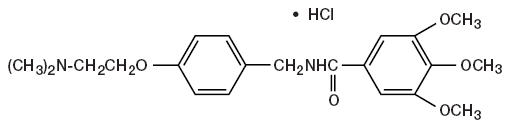
Chemically, trimethobenzamide HCl is N-[ p -[2-(dimethylamino)ethoxy]benzyl]-3,4,5-trimethoxybenzamide monohydrochloride. It has a molecular weight of 424.93 and the following structural formula: Each capsule for oral use contains trimethobenzamide hydrochloride equivalent to 300 mg. Inactive Ingredients: FDA/E172 Red Iron Oxide, gelatin, magnesium stearate, microcrystalline cellulose, sodium starch glycolate and titanium dioxide. The imprinting ink contains D&C Yellow #10 Lake, FD&C Blue #1, FD&C Blue #2, FD&C Red #40, Iron Oxide Black, propylene glycol and shellac glaze. Chemical Structure
Trimethobenzamide hydrochloride capsules are indicated for the treatment of postoperative nausea and vomiting and for nausea associated with gastroenteritis.
(See WARNINGS and PRECAUTIONS .) Dosage should be adjusted according to the indication for therapy, severity of symptoms and the response of the patient. Geriatric Patients Dose adjustment such as reducing the total dose administered at each dosing or increasing the dosing interval should be considered in elderly patients with renal impairment (creatinine clearance ?70 mL/min/1.73m 2 ). Final dose adjustment should be based upon integration of clinical efficacy and safety considerations. (See CLINICAL PHARMACOLOGY and PRECAUTIONS ). Patients with Renal Impairment In subjects with renal impairment (creatinine clearance ?70 mL/min/1.73m 2 ), dose adjustment such as reducing the total dose administered at each dosing or increasing the dosing interval should be considered. (See CLINICAL PHARMACOLOGY and PRECAUTIONS ). CAPSULES, 300 mg Usual Adult Dosage One 300 mg capsule t.i.d. or q.i.d.
Use of any dosage form in patients with known hypersensitivity to trimethobenzamide is contraindicated.
There have been reports of hypersensitivity reactions and Parkinson-like symptoms. There have been instances of hypotension reported following parenteral administration to surgical patients. There have been reports of blood dyscrasias, blurring of vision, coma, convulsions, depression of mood, diarrhea, disorientation, dizziness, drowsiness, headache, jaundice, muscle cramps and opisthotonos. If these occur, the administration of the drug should be discontinued. Allergic-type skin reactions have been observed; therefore, the drug should be discontinued at the first sign of sensitization. While these symptoms will usually disappear spontaneously, symptomatic treatment may be indicated in some cases.
Caution should be exercised when administering trimethobenzamide hydrochloride capsules to children for the treatment of vomiting. Antiemetics are not recommended for treatment of uncomplicated vomiting in children and their use should be limited to prolonged vomiting of known etiology. There are two principal reasons for caution: The extrapyramidal symptoms which can occur secondary to trimethobenzamide hydrochloride capsules may be confused with the central nervous system signs of an undiagnosed primary disease responsible for the vomiting, e.g., Reye's syndrome or other encephalopathy. It has been suspected that drugs with hepatotoxic potential, such as trimethobenzamide hydrochloride capsules, may unfavorably alter the course of Reye's syndrome. Such drugs should therefore be avoided in children whose signs and symptoms (vomiting) could represent Reye's syndrome. Trimethobenzamide hydrochloride capsules may produce drowsiness. Patients should not operate motor vehicles or other dangerous machinery until their individual responses have been determined. Usage in Pregnancy Trimethobenzamide hydrochloride was studied in reproduction experiments in rats and rabbits and no teratogenicity was suggested. The only effects observed were an increased percentage of embryonic resorptions or stillborn pups in rats administered 20 mg and 100 mg/kg and increased resorptions in rabbits receiving 100 mg/kg. In each study these adverse effects were attributed to one or two dams. The relevance to humans is not known. Since there is no adequate experience in pregnant or lactating women who have received this drug, safety in pregnancy or in nursing mothers has not been established. Usage with Alcohol Concomitant use of alcohol with trimethobenzamide hydrochloride capsules may result in an adverse drug interaction.