
İHALE DÜNYASI
İHALE DÜNYASI
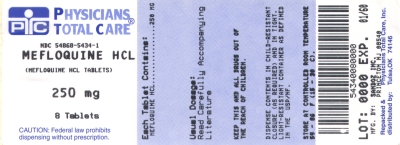
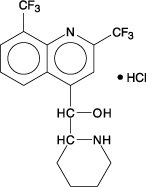
Mefloquine hydrochloride is an antimalarial agent available as 250 mg tablets of mefloquine hydrochloride (equivalent to 228.0 mg of the free base) for oral administration. Mefloquine hydrochloride is a 4-quinolinemethanol derivative with the specific chemical name of (R*, S*)-(±)-?-2-piperidinyl-2,8-bis (trifluoromethyl)-4-quinolinemethanol hydrochloride. It is a 2-aryl substituted chemical structural analog of quinine. The drug is a white to almost white crystalline compound, slightly soluble in water. Mefloquine hydrochloride has a calculated molecular weight of 414.78 and the following structural formula: The inactive ingredients are crospovidone, lactose monohydrate, low-substituted hydroxypropyl cellulose, magnesium stearate, microcrystalline cellulose, pregelatinized starch and talc. image of Mefloquine hydrochloride chemical structure
Treatment of Acute Malaria Infections Mefloquine hydrochloride tablets are indicated for the treatment of mild to moderate acute malaria caused by mefloquine-susceptible strains of P. falciparum (both chloroquine-susceptible and resistant strains) or by Plasmodium vivax . There are insufficient clinical data to document the effect of mefloquine in malaria caused by P. ovale or P. malariae . Note: Patients with acute P. vivax malaria, treated with mefloquine, are at high risk of relapse because mefloquine does not eliminate exoerythrocytic (hepatic phase) parasites. To avoid relapse, after initial treatment of the acute infection with mefloquine, patients should subsequently be treated with an 8-aminoquinoline derivative (e.g., primaquine). Prevention of Malaria Mefloquine hydrochloride tablets are indicated for the prophylaxis of P. falciparum and P. vivax malaria infections, including prophylaxis of chloroquine-resistant strains of P. falciparum .
(see INDICATIONS AND USAGE ) Adult Patients Treatment of mild to moderate malaria in adults caused by P. vivax or mefloquine-susceptible strains of P. falciparum Five tablets (1250 mg) mefloquine hydrochloride to be given as a single oral dose. The drug should not be taken on an empty stomach and should be administered with at least 8 oz (240 mL) of water. If a full-treatment course with mefloquine does not lead to improvement within 48 to 72 hours, mefloquine should not be used for retreatment. An alternative therapy should be used. Similarly, if previous prophylaxis with mefloquine has failed, mefloquine should not be used for curative treatment. Note: Patients with acute P. vivax malaria, treated with mefloquine, are at high risk of relapse because mefloquine does not eliminate exoerythrocytic (hepatic phase) parasites. To avoid relapse after initial treatment of the acute infection with mefloquine, patients should subsequently be treated with an 8-aminoquinoline derivative (eg, primaquine). Malaria Prophylaxis One 250 mg mefloquine hydrochloride tablet once weekly. Prophylactic drug administration should begin 1 week before arrival in an endemic area. Subsequent weekly doses should be taken regularly, always on the same day of each week, preferably after the main meal. To reduce the risk of malaria after leaving an endemic area, prophylaxis must be continued for 4 additional weeks to ensure suppressive blood levels of the drug when merozoites emerge from the liver. Tablets should not be taken on an empty stomach and should be administered with at least 8 oz (240 mL) of water. In certain cases, eg, when a traveler is taking other medication, it may be desirable to start prophylaxis 2 to 3 weeks prior to departure, in order to ensure that the combination of drugs is well tolerated (see PRECAUTIONS: Drug Interactions ). When prophylaxis with mefloquine fails, physicians should carefully evaluate which antimalarial to use for therapy. Pediatric Patients Treatment of mild to moderate malaria in pediatric patients caused by mefloquine-susceptible strains of P. falciparum Twenty (20) to 25 mg/kg body weight. Splitting the total therapeutic dose into 2 doses taken 6 to 8 hours apart may reduce the occurrence or severity of adverse effects. Experience with mefloquine in pediatric patients weighing less than 20 kg is limited. The drug should not be taken on an empty stomach and should be administered with ample water. The tablets may be crushed and suspended in a small amount of water, milk or other beverage for administration to small children and other persons unable to swallow them whole. If a full-treatment course with mefloquine does not lead to improvement within 48 to 72 hours, mefloquine should not be used for retreatment. An alternative therapy should be used. Similarly, if previous prophylaxis with mefloquine has failed, mefloquine should not be used for curative treatment. In pediatric patients, the administration of mefloquine for the treatment of malaria has been associated with early vomiting. In some cases, early vomiting has been cited as a possible cause of treatment failure (see PRECAUTIONS ). If a significant loss of drug product is observed or suspected because of vomiting, a second full dose of mefloquine should be administered to patients who vomit less than 30 minutes after receiving the drug. If vomiting occurs 30 to 60 minutes after a dose, an additional half-dose should be given. If vomiting recurs, the patient should be monitored closely and alternative malaria treatment considered if improvement is not observed within a reasonable period of time. The safety and effectiveness of mefloquine to treat malaria in pediatric patients below the age of 6 months have not been established. Malaria Prophylaxis The recommended prophylactic dose of mefloquine is approximately 5 mg/kg body weight once weekly. One 250 mg mefloquine hydrochloride tablet should be taken once weekly in pediatric patients weighing over 45 kg. In pediatric patients weighing less than 45 kg, the weekly dose decreases in proportion to body weight: 30 to 45 kg: 3/4 tablet 20 to 30 kg: 1/2 tablet Experience with mefloquine in pediatric patients weighing less than 20 kg is limited.
Use of mefloquine hydrochloride tablets is contraindicated in patients with a known hypersensitivity to mefloquine or related compounds (eg, quinine and quinidine) or to any of the excipients contained in the formulation. Mefloquine hydrochloride tablets should not be prescribed for prophylaxis in patients with active depression, a recent history of depression, generalized anxiety disorder, psychosis, or schizophrenia or other major psychiatric disorders, or with a history of convulsions.
Clinical At the doses used for treatment of acute malaria infections, the symptoms possibly attributable to drug administration cannot be distinguished from those symptoms usually attributable to the disease itself. Among subjects who received mefloquine for prophylaxis of malaria, the most frequently observed adverse experience was vomiting (3%). Dizziness, syncope, extrasystoles and other complaints affecting less than 1% were also reported. Among subjects who received mefloquine for treatment, the most frequently observed adverse experiences included: dizziness, myalgia, nausea, fever, headache, vomiting, chills, diarrhea, skin rash, abdominal pain, fatigue, loss of appetite, and tinnitus. Those side effects occurring in less than 1% included bradycardia, hair loss, emotional problems, pruritus, asthenia, transient emotional disturbances and telogen effluvium (loss of resting hair). Seizures have also been reported. Two serious adverse reactions were cardiopulmonary arrest in one patient shortly after ingesting a single prophylactic dose of mefloquine while concomitantly using propranolol (see PRECAUTIONS: Drug Interactions ), and encephalopathy of unknown etiology during prophylactic mefloquine administration. The relationship of encephalopathy to drug administration could not be clearly established. Postmarketing Postmarketing surveillance indicates that the same kind of adverse experiences are reported during prophylaxis, as well as acute treatment. Because these experiences are reported voluntarily from a population of uncertain size, it is not always possible to reliably estimate their frequency or establish a causal relationship to mefloquine exposure. The most frequently reported adverse events are nausea, vomiting, loose stools or diarrhea, abdominal pain, dizziness or vertigo, loss of balance, and neuropsychiatric events such as headache, somnolence, and sleep disorders (insomnia, abnormal dreams). These are usually mild and may decrease despite continued use. In a small number of patients it has been reported that dizziness or vertigo and loss of balance may continue for months after discontinuation of the drug. Occasionally, more severe neuropsychiatric disorders have been reported such as: sensory and motor neuropathies (including paresthesia, tremor and ataxia), convulsions, agitation or restlessness, anxiety, depression, mood swings, panic attacks, memory impairment, confusion, hallucinations, aggression, psychotic or paranoid reactions and encephalopathy. Rare cases of suicidal ideation and suicide have been reported though no relationship to drug administration has been confirmed. Other less frequently reported adverse events include: Cardiovascular Disorders circulatory disturbances (hypotension, hypertension, flushing, syncope), chest pain, tachycardia or palpitation, bradycardia, irregular heart rate, extrasystoles, A-V block, and other transient cardiac conduction alterations. Skin Disorders rash, exanthema, erythema, urticaria, pruritus, edema, hair loss, erythema multiforme, and Stevens-Johnson syndrome. Musculoskeletal Disorders muscle weakness, muscle cramps, myalgia, and arthralgia. Respiratory Disorders dyspnea, pneumonitis of possible allergic etiology Other Symptoms visual disturbances, vestibular disorders including tinnitus and hearing impairment, asthenia, malaise, fatigue, fever, hyperhidrosis, chills, dyspepsia and loss of appetite. Laboratory The most frequently observed laboratory alterations which could be possibly attributable to drug administration were decreased hematocrit, transient elevation of transaminases, leukopenia and thrombocytopenia. These alterations were observed in patients with acute malaria who received treatment doses of the drug and were attributed to the disease itself. During prophylactic administration of mefloquine to indigenous populations in malaria-endemic areas, the following occasional alterations in laboratory values were observed: transient elevation of transaminases, leukocytosis or thrombocytopenia. Because of the long half-life of mefloquine, adverse reactions to mefloquine may occur or persist up to several weeks after discontinuation of the drug.
In case of life-threatening, serious or overwhelming malaria infections due to P. falciparum, patients should be treated with an intravenous antimalarial drug. Following completion of intravenous treatment, mefloquine may be given to complete the course of therapy. Halofantrine should not be administered with mefloquine or within 15 weeks of the last dose of mefloquine due to the risk of a potentially fatal prolongation of the QTc interval (see CLINICAL PHARMACOLOGY: Pharmacokinetics: Elimination ). Ketoconazole should not be administered with mefloquine or within 15 weeks of the last dose of mefloquine due to the risk of a potentially fatal prolongation of the QTc interval. Ketoconazole increases plasma concentrations and elimination half-life of mefloquine following co-administration (see CLINICAL PHARMACOLOGY: Pharmacokinetics: Elimination and PRECAUTIONS: Drug Interactions ). Mefloquine may cause psychiatric symptoms in a number of patients, ranging from anxiety, paranoia, and depression to hallucinations and psychotic behavior. On occasions, these symptoms have been reported to continue long after mefloquine has been stopped. Rare cases of suicidal ideation and suicide have been reported though no relationship to drug administration has been confirmed. To minimize the chances of these adverse events, mefloquine should not be taken for prophylaxis in patients with active depression or with a recent history of depression, generalized anxiety disorder, psychosis, or schizophrenia or other major psychiatric disorders. Mefloquine should be used with caution in patients with a previous history of depression. During prophylactic use, if psychiatric symptoms such as acute anxiety, depression, restlessness or confusion occur, these may be considered prodromal to a more serious event. In these cases, the drug must be discontinued and an alternative medication should be substituted. Concomitant administration of mefloquine and quinine or quinidine may produce electrocardiographic abnormalities. Concomitant administration of mefloquine and quinine or chloroquine may increase the risk of convulsions.