
İHALE DÜNYASI
İHALE DÜNYASI
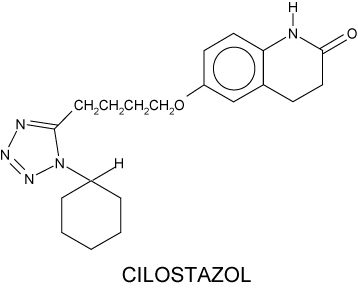

Cilostazol is a quinolinone derivative that inhibits cellular phosphodiesterase (more specific for phosphodiesterase III). The empirical formula of cilostazol is C 20 H 27 N 5 O 2 , and its molecular weight is 369.46. Cilostazol is 6-[4-(1-cyclohexyl-1 H -tetrazol-5-yl)butoxy]-3,4-dihydro-2(1 H )-quinolinone, CAS-73963-72-1. The structural formula is: Cilostazol occurs as white to off-white crystals or as a crystalline powder that is slightly soluble in methanol and ethanol, and is practically insoluble in water, 0.1 N HCl, and 0.1 N NaOH. Cilostazol Tablets, USP for oral administration are available as 50 mg or 100 mg round, white debossed tablets. Each tablet, in addition to the active ingredient, contains the following inactive ingredients: carboxymethylcellulose calcium, corn starch, hypromellose, magnesium stearate and microcrystalline cellulose. Chemical Structure
Cilostazol Tablets, USP are indicated for the reduction of symptoms of intermittent claudication, as indicated by an increased walking distance.
The recommended dosage of cilostazol is 100 mg b.i.d. taken at least half an hour before or two hours after breakfast and dinner. A dose of 50 mg b.i.d. should be considered during coadministration of such inhibitors of CYP3A4 as ketoconazole, itraconazole, erythromycin and diltiazem, and during coadministration of such inhibitors of CYP2C19 as omeprazole. Patients may respond as early as 2 to 4 weeks after the initiation of therapy, but treatment for up to 12 weeks may be needed before a beneficial effect is experienced. Discontinuation of Therapy The available data suggest that the dosage of cilostazol can be reduced or discontinued without rebound (i.e., platelet hyperaggregability).
Cilostazol and several of its metabolites are inhibitors of phosphodiesterase III. Several drugs with this pharmacologic effect have caused decreased survival compared to placebo in patients with class III-IV congestive heart failure. Cilostazol Tablets, USP are contraindicated in patients with congestive heart failure of any severity. Cilostazol Tablets, USP are contraindicated in patients with haemostatic disorders or active pathologic bleeding, such as bleeding peptic ulcer and intracranial bleeding. Cilostazol Tablets, USP inhibit platelet aggregation in a reversible manner. Cilostazol Tablets, USP are contraindicated in patients with known or suspected hypersensitivity to any of its components.
Adverse events were assessed in eight placebo-controlled clinical trials involving 2274 patients exposed to either 50 or 100 mg b.i.d. cilostazol tablets (n=1301) or placebo (n=973), with a median treatment duration of 127 days for patients on cilostazol and 134 days for patients on placebo. The only adverse event resulting in discontinuation of therapy in ? 3% of patients treated with cilostazol 50 or 100 mg b.i.d. was headache, which occurred with an incidence of 1.3%, 3.5%, and 0.3% in patients treated with cilostazol 50 mg b.i.d., 100 mg b.i.d. or placebo, respectively. Other frequent causes of discontinuation included palpitation and diarrhea, both 1.1% for cilostazol (all doses) versus 0.1% for placebo. The most commonly reported adverse events, occurring in ? 2% of patients treated with cilostazol 50 or 100 mg b.i.d., are shown in the table below. Other events seen with an incidence of ? 2%, but occurring in the placebo group at least as frequently as in the 100 mg b.i.d. group were: asthenia, hypertension, vomiting, leg cramps, hyperesthesia, paresthesia, dyspnea, rash, hematuria, urinary tract infection, flu syndrome, angina pectoris, arthritis, and bronchitis. Most Commonly Reported AEs (Incidence ?2%) in Patients on Cilostazol 50 mg b.i.d. or 100 mg b.i.d. and Occurring at a Rate in the 100 mg b.i.d. Group Higher Than in Patients on Placebo Adverse Events (AEs) by Body System Cilostazol 50 mg b.i.d. (N=303) % Cilostazol 100 mg b.i.d. (N=998) % Placebo (N=973) % BODY AS A WHOLE Abdominal pain 4 5 3 Back pain 6 7 6 Headache 27 34 14 Infection 14 10 8 CARDIOVASCULAR Palpitation 5 10 1 Tachycardia 4 4 1 DIGESTIVE Abnormal stools 12 15 4 Diarrhea 12 19 7 Dyspepsia 6 6 4 Flatulence 2 3 2 Nausea 6 7 6 METABOLIC & NUTRITIONAL Peripheral edema 9 7 4 MUSCULO-SKELETAL Myalgia 2 3 2 NERVOUS Dizziness 9 10 6 Vertigo 3 1 1 RESPIRATORY Cough increased 3 4 3 Pharyngitis 7 10 7 Rhinitis 12 7 5 Less frequent adverse events (< 2%) that were experienced by patients exposed to cilostazol 50 mg b.i.d. or 100 mg b.i.d. in the eight controlled clinical trials and that occurred at a frequency in the 100 mg b.i.d. group greater than in the placebo group, regardless of suspected drug relationship, are listed below. Body As a Whole: Chills, face edema, fever, generalized edema, malaise, neck rigidity, pelvic pain, retroperitoneal hemorrhage. Cardiovascular: Atrial fibrillation, atrial flutter, cerebral infarct, cerebral ischemia, congestive heart failure, heart arrest, hemorrhage, hypotension, myocardial infarction, myocardial ischemia, nodal arrhythmia, postural hypotension, supraventricular tachycardia, syncope, varicose vein, vasodilation, ventricular extrasystoles, ventricular tachycardia. Digestive: Anorexia, cholelithiasis, colitis, duodenal ulcer, duodenitis, esophageal hemorrhage, esophagitis, increased GGT, gastritis, gastroenteritis, gum hemorrhage, hematemesis, melena, peptic ulcer, periodontal abscess, rectal hemorrhage, stomach ulcer, tongue edema. Endocrine: Diabetes mellitus. Hemic and Lymphatic: Anemia, ecchymosis, iron deficiency anemia, polycythemia, purpura. Metabolic and Nutritional: : Increased creatinine, gout, hyperlipemia, hyperuricemia. Musculoskeletal: Arthralgia, bone pain, bursitis. Nervous: Anxiety, insomnia, neuralgia. Respiratory: Asthma, epistaxis, hemoptysis, pneumonia, sinusitis. Skin and Appendages: Dry skin, furunculosis, skin hypertrophy, urticaria. Special Senses: Amblyopia, blindness, conjunctivitis, diplopia, ear pain, eye hemorrhage, retinal hemorrhage, tinnitus. Urogenital: Albuminuria, cystitis, urinary frequency, vaginal hemorrhage, vaginitis Post Marketing Experience The following adverse events have been reported spontaneously from worldwide post-marketing experience since launch of cilostazol in the US. Blood and lymphatic system disorders: agranulocytosis, aplastic anemia, granulocytopenia, thrombocytopenia, leukopenia, bleeding tendency Cardiac disorders: Torsades de pointes, QTc prolongation (Torsades de pointes and QTc prolongation occurred in patients with cardiac disorders, e.g. complete atrioventricular block, cardiac failure and bradyarrythmia, when treated with cilostazol. Cilostazol was used "off label" due to its positive chronotropic action.) Gastrointestinal disorders: gastrointestinal hemorrhage General disorders and administration site conditions: pain, chest pain, hot flushes Hepatobiliary disorders: hepatic dysfunction/abnormal liver function tests, jaundice Injury, poisoning and procedural complications: extradural hematoma and subdural hematoma Investigations : blood glucose increased, blood uric acid increased, platelet count decreased, white blood cell count decreased, increase in BUN (blood urea increased), blood pressure increase Nervous system disorders: intracranial hemorrhage, cerebral hemorrhage, cerebrovascular accident Respiratory, thoracic and mediastinal disorders: pulmonary hemorrhage, interstitial pneumonia Skin and subcutaneous tissue disorders: hemorrhage subcutaneous, pruritus, skin eruptions including Stevens-Johnson syndrome, skin drug eruption (dermatitis medicamentosa) Vascular disorders: subacute thrombosis (These cases of subacute thrombosis occurred in patients treated with aspirin and "off label" use of cilostazol for prevention of thrombotic complication after coronary stenting.)
BOXED WARNING: CONTRAINDICATION Cilostazol and several of its metabolites are inhibitors of phosphodiesterase III. Several drugs with this pharmacologic effect have caused decreased survival compared to placebo in patients with class III-IV congestive heart failure. Cilostazol is contraindicated in patients with congestive heart failure of any severity.
Since Cilostazol Tablets, USP is extensively metabolized by cytochrome P-450 isoenzymes, caution should be exercised when Cilostazol Tablets, USP is coadministered with inhibitors of CYP3A4 such as ketoconazole and erythromycin or inhibitors of CYP2C19 such as omeprazole. Pharmacokinetic studies have demonstrated that omeprazole and erythromycin significantly increased the systemic exposure of cilostazol and/or its major metabolites. Population pharmacokinetic studies showed higher concentrations of cilostazol among patients concurrently treated with diltiazem, an inhibitor of CYP3A4 (see CLINICAL PHARMACOLOGY, Pharmacokinetic and Pharmacodynamic Drug-Drug Interactions ). Cilostazol Tablets, USP does not, however, appear to cause increased blood levels of drugs metabolized by CYP3A4, as it had no effect on lovastatin, a drug with metabolism very sensitive to CYP3A4 inhibition.