
İHALE DÜNYASI
İHALE DÜNYASI
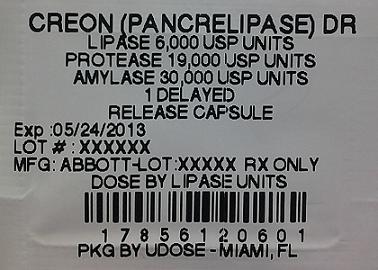
CREON is a pancreatic enzyme preparation consisting of pancrelipase, an extract derived from porcine pancreatic glands. Pancrelipase contains multiple enzyme classes, including porcine-derived lipases, proteases, and amylases. Pancrelipase is a beige-white amorphous powder. It is miscible in water and practically insoluble or insoluble in alcohol and ether. Each delayed-release capsule for oral administration contains enteric-coated spheres (0.71-1.60 mm in diameter). The active ingredient evaluated in clinical trials is lipase. CREON is dosed by lipase units. Other active ingredients include protease and amylase. CREON contains the following inactive ingredients: cetyl alcohol, dimethicone, hypromellose phthalate, polyethylene glycol, and triethyl citrate. 9,500 USP units of protease; 15,000 USP units of amylase delayed-release capsules have a white opaque cap with imprint "CREON 1203" and a white opaque body. The shells contain titanium dioxide and hypromellose. 3,000 USP units of lipase; 19,000 USP units of protease; 30,000 USP units of amylase delayed-release capsules have a Swedish-orange opaque cap with imprint "CREON 1206" and a blue opaque body. The shells contain FD&C Blue No. 2, gelatin, red iron oxide, sodium lauryl sulfate, titanium dioxide, and yellow iron oxide. 6,000 USP units of lipase; 38,000 USP units of protease; 60,000 USP units of amylase delayed-release capsules have a brown opaque cap with imprint "CREON 1212" and a colorless transparent body. The shells contain black iron oxide, gelatin, red iron oxide, sodium lauryl sulfate, titanium dioxide, and yellow iron oxide. 12,000 USP units of lipase; 76,000 USP units of protease; 120,000 USP units of amylase delayed-release capsules have a Swedish-orange opaque cap with imprint "CREON 1224" and a colorless transparent body. The shells contain gelatin, red iron oxide, sodium lauryl sulfate, titanium dioxide, and yellow iron oxide. 24,000 USP units of lipase;
CREON (pancrelipase) is indicated for the treatment of exocrine pancreatic insufficiency due to cystic fibrosis, chronic pancreatitis, pancreatectomy, or other conditions. (R) CREON is a combination of porcine-derived lipases, proteases, and amylases indicated for the treatment of exocrine pancreatic insufficiency due to cystic fibrosis, chronic pancreatitis, pancreatectomy, or other conditions. ( ) 1
CREON is not interchangeable with other pancrelipase products. CREON is orally administered. Therapy should be initiated at the lowest recommended dose and gradually increased. The dosage of CREON should be individualized based on clinical symptoms, the degree of steatorrhea present, and the fat content of the diet as described in the Limitations on Dosing below . [see Dosage and Administration ( ) and Warnings and Precautions ( )] 2.2 5.1 CREON is not interchangeable with any other pancrelipase product. ( ) 2.1 Do not crush or chew capsules and capsule contents. For infants or patients unable to swallow intact capsules, the contents may be sprinkled on soft acidic food, e.g., applesauce. ( ) Dosing should not exceed the recommended maximum dosage set forth by the Cystic Fibrosis Foundation Consensus Conferences Guidelines. ( ) 2.1 2.2 Infants (up to 12 months) Prior to each feeding, infants may be given 3,000 lipase units (one capsule) per 120 mL of formula or per breast-feeding. ( ) 2.1 Do not mix CREON capsule contents directly into formula or breast milk prior to administration. ( ) 2.1 Children Older than 12 Months and Younger than 4 Years Begin with 1,000 lipase units/kg of body weight per meal for children less than age 4 years to a maximum of 2,500 lipase units/kg of body weight per meal (or less than or equal to 10,000 lipase units/kg of body weight per day), or less than 4,000 lipase units/g fat ingested per day. ( ) 2.2 Children 4 Years and Older and Adults Begin with 500 lipase units/kg of body weight per meal for those older than age 4 years to a maximum of 2,500 lipase units/kg of body weight per meal (or less than or equal to 10,000 lipase units/kg of body weight per day), or less than 4,000 lipase units/g fat ingested per day. ( ) 2.2 Adults with Exocrine Pancreatic Insufficiency Due to Chronic Pancreatitis or Pancreatectomy Individualize dosage based on clinical symptoms, the degree of steatorrhea present and the fat content of the diet. ( ) 2.2 2.1 Administration Infants (up to 12 months) CREON should be administered to infants immediately prior to each feeding, using a dosage of lipase units per 120 mL of formula or prior to breast-feeding. Contents of the capsule may be administered directly to the mouth or with a small amount of applesauce. Administration should be followed by breast milk or formula. Contents of the capsule be mixed directly into formula or breast milk as this may diminish efficacy. Care should be taken to ensure that CREON is not crushed or chewed or retained in the mouth, to avoid irritation of the oral mucosa. 3,000 should not Children and Adults CREON should be taken during meals or snacks, with sufficient fluid. Capsules should be swallowed whole. CREON capsules and capsule contents should not be crushed or chewed. For patients who are unable to swallow intact capsules, the capsules may be carefully opened and the contents added to a small amount of acidic soft food with a pH of 4.5 or less, such as applesauce, at room temperature. The CREON-soft food mixture should be swallowed immediately without crushing or chewing, and followed with water or juice to ensure complete ingestion. Care should be taken to ensure that no drug is retained in the mouth. 2.2 Dosage Dosage recommendations for pancreatic enzyme replacement therapy were published following the Cystic Fibrosis Foundation Consensus Conferences. CREON should be administered in a manner consistent with the recommendations of the Patients may be dosed on a fat ingestion-based or actual body weight-based dosing scheme. 1, 2, 3 Cystic Fibrosis Foundation Consensus Conferences (also known as Conferences) provided in the following paragraphs, except for infants. Although the Conferences recommend doses of 2,000 to 4,000 lipase units in infants up to 12 months, CREON is available in a 3,000 lipase unit capsule. Therefore, the recommended dose of CREON in infants up to 12 months is 3,000 lipase units per 120 mL of formula or per breast-feeding. Additional recommendations for pancreatic enzyme therapy in patients with exocrine pancreatic insufficiency due to chronic pancreatitis or pancreatectomy are based on a clinical trial conducted in these populations. Infants (up to 12 months) CREON is available in the strength of 3,000 USP units of lipase thus infants may be given 3,000 lipase units (one capsule) per 120 mL of formula or per breast-feeding. Do not mix CREON capsule contents directly into formula or breast milk prior to administration . [see Administration ( )] 2.1 Children Older than 12 Months and Younger than 4 Years Enzyme dosing should begin with 1,000 lipase units/kg of body weight per meal for children less than age 4 years to a maximum of 2,500 lipase units/kg of body weight per meal (or less than or equal to 10,000 lipase units/kg of body weight per day), or less than 4,000 lipase units/g fat ingested per day. Children 4 Years and Older and Adults Enzyme dosing should begin with 500 lipase units/kg of body weight per meal for those older than age 4 years to a maximum of 2,500 lipase units/kg of body weight per meal (or less than or equal to 10,000 lipase units/kg of body weight per day), or less than 4,000 lipase units/g fat ingested per day. Usually, half of the prescribed CREON dose for an individualized full meal should be given with each snack. The total daily dose should reflect approximately three meals plus two or three snacks per day. Enzyme doses expressed as lipase units/kg of body weight per meal should be decreased in older patients because they weigh more but tend to ingest less fat per kilogram of body weight. Adults with Exocrine Pancreatic Insufficiency Due to Chronic Pancreatitis or Pancreatectomy The initial starting dose and increases in the dose per meal should be individualized based on clinical symptoms, the degree of steatorrhea present, and the fat content of the diet. In one clinical trial, patients received CREON at a dose of 72,000 lipase units per meal while consuming at least 100 g of fat per day . Lower starting doses recommended in the literature are consistent with the 500 lipase units/kg of body weight per meal lowest starting dose recommended for adults in the Cystic Fibrosis Foundation Consensus Conferences Guidelines. Usually, half of the prescribed CREON dose for an individualized full meal should be given with each snack. [see Clinical Studies ( )] 14.2 1, 2, 3, 4 Limitations on Dosing Dosing should not exceed the recommended maximum dosage set forth by the Cystic Fibrosis Foundation Consensus Conferences Guidelines. If symptoms and signs of steatorrhea persist, the dosage may be increased by the healthcare professional. Patients should be instructed not to increase the dosage on their own. There is great inter-individual variation in response to enzymes; thus, a range of doses is recommended. Changes in dosage may require an adjustment period of several days. If doses are to exceed 2,500 lipase units/kg of body weight per meal, further investigation is warranted. Doses greater than 2,500 lipase units/kg of body weight per meal (or greater than 10,000 lipase units/kg of body weight per day) should be used with caution and only if they are documented to be effective by 3-day fecal fat measures that indicate a significantly improved coefficient of fat absorption. Doses greater than 6,000 lipase units/kg of body weight per meal have been associated with colonic stricture, indicative of fibrosing colonopathy, in children less than 12 years of age . Patients currently receiving higher doses than 6,000 lipase units/kg of body weight per meal should be examined and the dosage either immediately decreased or titrated downward to a lower range. 1, 2, 3 [see Warnings and Precautions ( )] 5.1
None. None ( ) 4
The most serious adverse reactions reported with different pancreatic enzyme products of the same active ingredient (pancrelipase) that are described elsewhere in the label include fibrosing colonopathy, hyperuricemia and allergic reactions . [see Warnings and Precautions ( )] 5 Adverse reactions occurring in at least 2 cystic fibrosis patients (greater than or equal to 4%) receiving CREON are vomiting, dizziness, and cough. ( ) 6.1 Adverse reactions that occurred in at least 1 chronic pancreatitis or pancreatectomy patient (greater than or equal to 4%) receiving CREON are hyperglycemia, hypoglycemia, abdominal pain, abnormal feces, flatulence, frequent bowel movements, and nasopharyngitis. ( ) 6.1 To report SUSPECTED ADVERSE REACTIONS, contact Abbott Laboratories at 1-800-241-1643 or FDA at 1-800-FDA-1088 or www.fda.gov/medwatch. 6.1 Clinical Trials Experience Because clinical trials are conducted under widely varying conditions, adverse reaction rates observed in the clinical trials of a drug cannot be directly compared to the rates in the clinical trials of another drug and may not reflect the rates observed in practice. The short-term safety of CREON was assessed in clinical trials conducted in 121 patients with exocrine pancreatic insufficiency (EPI): 67 patients with EPI due to cystic fibrosis (CF) and 25 patients with EPI due to chronic pancreatitis or pancreatectomy were treated with CREON. Cystic Fibrosis Studies 1 and 2 were randomized, double-blind, placebo-controlled, crossover studies of 49 patients, ages 7 to 43 years, with EPI due to CF. Study 1 included 32 patients ages 12 to 43 years and Study 2 included 17 patients ages 7 to 11 years. In these studies, patients were randomized to receive CREON at a dose of 4,000 lipase units/g fat ingested per day or matching placebo for 5 to 6 days of treatment, followed by crossover to the alternate treatment for an additional 5 to 6 days. The mean exposure to CREON during these studies was 5 days. In Study 1, one patient experienced duodenitis and gastritis of moderate severity 16 days after completing treatment with CREON. Transient neutropenia without clinical sequelae was observed as an abnormal laboratory finding in one patient receiving CREON and a macrolide antibiotic. In Study 2, adverse reactions that occurred in at least 2 patients (greater than or equal to 12%) treated with CREON were vomiting and headache. Vomiting occurred in 2 patients treated with CREON and did not occur in patients treated with placebo; headache occurred in 2 patients treated with CREON and did not occur in patients treated with placebo. The most common adverse reactions (greater than or equal to 4%) in Studies 1 and 2 were vomiting, dizziness, and cough. enumerates adverse reactions that occurred in at least 2 patients (greater than or equal to 4%) treated with CREON at a higher rate than with placebo in Studies 1 and 2. Table 1 Table 1: Adverse Reactions Occurring in at Least 2 Patients (greater than or equal to 4%) in Cystic Fibrosis (Studies 1 and 2) Adverse Reaction CREON Capsules n = 49 (%) Placebo n = 47 (%) Vomiting 3 (6) 1 (2) Dizziness 2 (4) 1 (2) Cough 2 (4) 0 An additional open-label, single-arm study assessed the short-term safety and tolerability of CREON in 18 infants and children, ages 4 months to 6 years, with EPI due to cystic fibrosis. Patients received their usual pancreatic enzyme replacement therapy (mean dose of 7,000 lipase units/kg/day for a mean duration of 18.2 days) followed by CREON (mean dose of 7,500 lipase units/kg/day for a mean duration of 12.6 days). There were no serious adverse reactions. Adverse reactions that occurred in patients during treatment with CREON were vomiting, irritability, and decreased appetite, each occurring in 6% of patients. Chronic Pancreatitis or Pancreatectomy A randomized, double-blind, placebo-controlled, parallel group study was conducted in 54 adult patients, ages 32 to 75 years, with EPI due to chronic pancreatitis or pancreatectomy. Patients received single-blind placebo treatment during a 5-day run-in period followed by an intervening period of up to 16 days of investigator-directed treatment with no restrictions on pancreatic enzyme replacement therapy. Patients were then randomized to receive CREON or matching placebo for 7 days. The CREON dose was 72,000 lipase units per main meal (3 main meals) and 36,000 lipase units per snack (2 snacks). The mean exposure to CREON during this study was 6.8 days in the 25 patients that received CREON. The most common adverse reactions reported during the study were related to glycemic control and were reported more commonly during CREON treatment than during placebo treatment. enumerates adverse reactions that occurred in at least 1 patient (greater than or equal to 4%) treated with CREON at a higher rate than with placebo. Table 2 Table 2: Adverse Reactions in at Least 1 Patient (greater than or equal to 4%) in the Chronic Pancreatitis or Pancreatectomy Trial Adverse Reaction CREON Capsules n = 25 (%) Placebo n = 29 (%) Hyperglycemia 2 (8) 2 (7) Hypoglycemia 1 (4) 1 (3) Abdominal Pain 1 (4) 1 (3) Abnormal Feces 1 (4) 0 Flatulence 1 (4) 0 Frequent Bowel Movements 1 (4) 0 Nasopharyngitis 1 (4) 0 6.2 Postmarketing Experience Postmarketing data from this formulation of CREON have been available since 2009. The following adverse reactions have been identified during post approval use of this formulation of CREON. Because these reactions are reported voluntarily from a population of uncertain size, it is not always possible to reliably estimate their frequency or establish a causal relationship to drug exposure. Gastrointestinal disorders (including abdominal pain, diarrhea, flatulence, constipation and nausea), skin disorders (including pruritus, urticaria and rash), blurred vision, myalgia, muscle spasm, and asymptomatic elevations of liver enzymes have been reported with this formulation of CREON. Delayed- and immediate-release pancreatic enzyme products with different formulations of the same active ingredient (pancrelipase) have been used for the treatment of patients with exocrine pancreatic insufficiency due to cystic fibrosis and other conditions, such as chronic pancreatitis. The long-term safety profile of these products has been described in the medical literature. The most serious adverse reactions included fibrosing colonopathy, distal intestinal obstruction syndrome (DIOS), recurrence of pre-existing carcinoma, and severe allergic reactions including anaphylaxis, asthma, hives, and pruritus.
Fibrosing colonopathy is associated with high-dose use of pancreatic enzyme replacement in the treatment of cystic fibrosis patients. Exercise caution when doses of CREON exceed 2,500 lipase units/kg of body weight per meal (or greater than 10,000 lipase units/kg of body weight per day). ( ) 5.1 To avoid irritation of oral mucosa, do not chew CREON or retain in the mouth. ( ) 5.2 Exercise caution when prescribing CREON to patients with gout, renal impairment, or hyperuricemia. ( ) 5.3 There is theoretical risk of viral transmission with all pancreatic enzyme products including CREON. ( ) 5.4 Exercise caution when administering pancrelipase to a patient with a known allergy to proteins of porcine origin. ( ) 5.5 5.1 Fibrosing Colonopathy Fibrosing colonopathy has been reported following treatment with different pancreatic enzyme products. Fibrosing colonopathy is a rare, serious adverse reaction initially described in association with high-dose pancreatic enzyme use, usually over a prolonged period of time and most commonly reported in pediatric patients with cystic fibrosis. The underlying mechanism of fibrosing colonopathy remains unknown. Doses of pancreatic enzyme products exceeding 6,000 lipase units/kg of body weight per meal have been associated with colonic stricture in children less than 12 years of age. Patients with fibrosing colonopathy should be closely monitored because some patients may be at risk of progressing to stricture formation. It is uncertain whether regression of fibrosing colonopathy occurs. It is generally recommended, unless clinically indicated, that enzyme doses should be less than 2,500 lipase units/kg of body weight per meal (or less than 10,000 lipase units/kg of body weight per day) or less than 4,000 lipase units/g fat ingested per day 5, 6 1 1 [see Dosage and Administration ( )]. 2.1 Doses greater than 2,500 lipase units/kg of body weight per meal (or greater than 10,000 lipase units/kg of body weight per day) should be used with caution and only if they are documented to be effective by 3-day fecal fat measures that indicate a significantly improved coefficient of fat absorption. Patients receiving higher doses than 6,000 lipase units/kg of body weight per meal should be examined and the dosage either immediately decreased or titrated downward to a lower range. 5.2 Potential for Irritation to Oral Mucosa Care should be taken to ensure that no drug is retained in the mouth. CREON should not be crushed or chewed or mixed in foods having a pH greater than 4.5. These actions can disrupt the protective enteric coating resulting in early release of enzymes, irritation of oral mucosa, and/or loss of enzyme activity . For patients who are unable to swallow intact capsules, the capsules may be carefully opened and the contents added to a small amount of acidic soft food with a pH of 4.5 or less, such as applesauce, at room temperature. The CREON-soft food mixture should be swallowed immediately and followed with water or juice to ensure complete ingestion. [see Dosage and Administration ( ) and Patient Counseling Information ( )] 2.2 17.1 5.3 Potential for Risk of Hyperuricemia Caution should be exercised when prescribing CREON to patients with gout, renal impairment, or hyperuricemia. Porcine-derived pancreatic enzyme products contain purines that may increase blood uric acid levels. 5.4 Potential Viral Exposure from the Product Source CREON is sourced from pancreatic tissue from swine used for food consumption. Although the risk that CREON will transmit an infectious agent to humans has been reduced by testing for certain viruses during manufacturing and by inactivating certain viruses during manufacturing, there is a theoretical risk for transmission of viral disease, including diseases caused by novel or unidentified viruses. Thus, the presence of porcine viruses that might infect humans cannot be definitely excluded. However, no cases of transmission of an infectious illness associated with the use of porcine pancreatic extracts have been reported. 5.5 Allergic Reactions Caution should be exercised when administering pancrelipase to a patient with a known allergy to proteins of porcine origin. Rarely, severe allergic reactions including anaphylaxis, asthma, hives, and pruritus, have been reported with other pancreatic enzyme products with different formulations of the same active ingredient (pancrelipase). The risks and benefits of continued CREON treatment in patients with severe allergy should be taken into consideration with the overall clinical needs of the patient.
No drug interactions have been identified. No formal interaction studies have been conducted.