
İHALE DÜNYASI
İHALE DÜNYASI
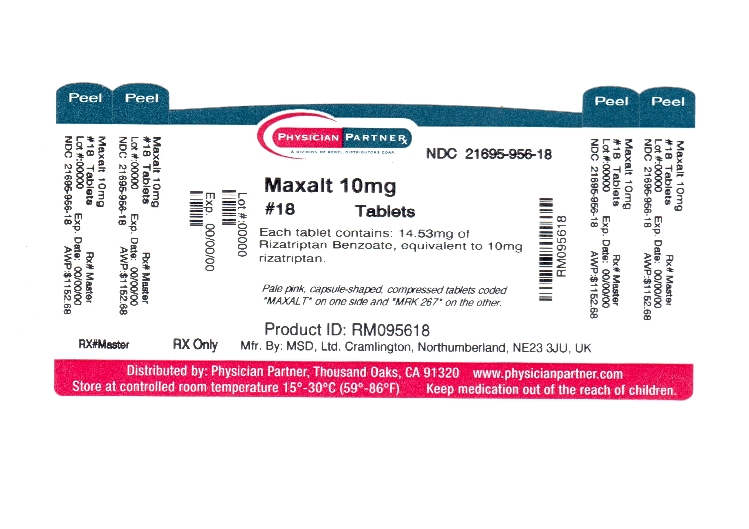
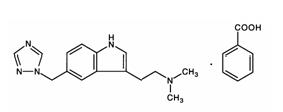
MAXALT COPYRIGHT (c) 1998, 2006 Merck Sharp & Dohme Corp., a subsidiary of Merck & Co., Inc. All rights reserved contains rizatriptan benzoate, a selective 5-hydroxytryptamine 1B/1D (5-HT 1B/1D ) receptor agonist. Rizatriptan benzoate is described chemically as: N,N -dimethyl-5-(1 H -1,2,4-triazol-1-ylmethyl)-1 H -indole-3-ethanamine monobenzoate and its structural formula is: Its empirical formula is C 15 H 19 N 5 *C 7 H 6 O 2 , representing a molecular weight of the free base of 269.4. Rizatriptan benzoate is a white to off-white, crystalline solid that is soluble in water at about 42 mg per mL (expressed as free base) at 25°C. MAXALT Tablets and MAXALT-MLT COPYRIGHT (c) 1998, 2006 Merck Sharp & Dohme Corp., a subsidiary of Merck & Co., Inc. All rights reserved Orally Disintegrating Tablets are available for oral administration in strengths of 5 and 10 mg (corresponding to 7.265 mg or 14.53 mg of the benzoate salt, respectively). Each compressed tablet contains the following inactive ingredients: lactose monohydrate, microcrystalline cellulose, pregelatinized starch, ferric oxide (red), and magnesium stearate. Each lyophilized orally disintegrating tablet contains the following inactive ingredients: gelatin, mannitol, glycine, aspartame, and peppermint flavor. image of structural formula
MAXALT is indicated for the acute treatment of migraine attacks with or without aura in adults. MAXALT is not intended for the prophylactic therapy of migraine or for use in the management of hemiplegic or basilar migraine (see CONTRAINDICATIONS ). Safety and effectiveness of MAXALT have not been established for cluster headache, which is present in an older, predominantly male population.
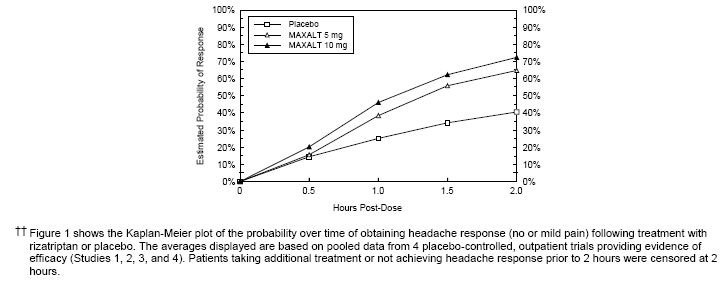
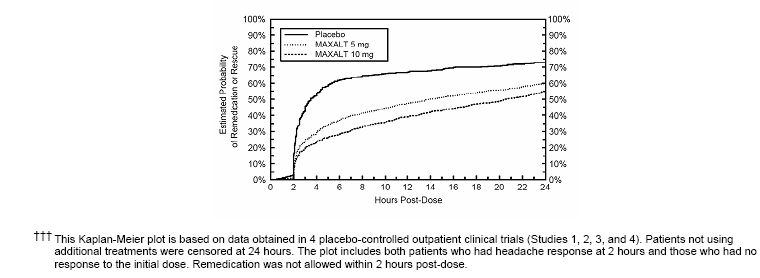
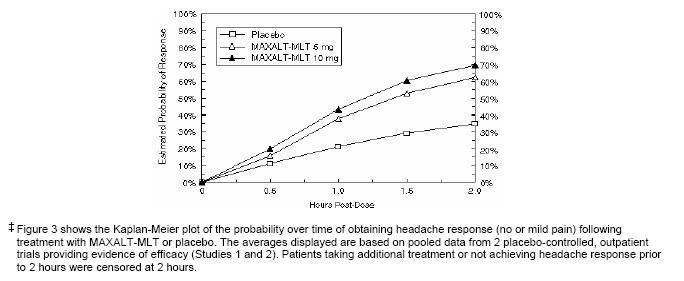
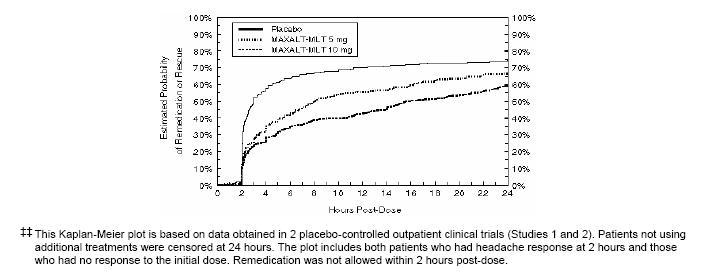
In controlled clinical trials, single doses of 5 and 10 mg of MAXALT Tablets or MAXALT-MLT were effective for the acute treatment of migraines in adults. There is evidence that the 10-mg dose may provide a greater effect than the 5-mg dose (see CLINICAL PHARMACOLOGY, Clinical Studies ). Individuals may vary in response to doses of MAXALT Tablets. The choice of dose should therefore be made on an individual basis, weighing the possible benefit of the 10-mg dose with the potential risk for increased adverse events. Redosing: Doses should be separated by at least 2 hours; no more than 30 mg should be taken in any 24-hour period. The safety of treating, on average, more than four headaches in a 30-day period has not been established. Patients receiving propranolol: In patients receiving propranolol, the 5-mg dose of MAXALT should be used, up to a maximum of 3 doses in any 24-hour period. (See CLINICAL PHARMACOLOGY, Drug Interactions .) For MAXALT-MLT Orally Disintegrating Tablets, administration with liquid is not necessary. The orally disintegrating tablet is packaged in a blister within an outer aluminum pouch. Patients should be instructed not to remove the blister from the outer pouch until just prior to dosing. The blister pack should then be peeled open with dry hands and the orally disintegrating tablet placed on the tongue, where it will dissolve and be swallowed with the saliva.
MAXALT should not be given to patients with ischemic heart disease (e.g., angina pectoris, history of myocardial infarction, or documented silent ischemia) or to patients who have symptoms or findings consistent with ischemic heart disease, coronary artery vasospasm, including Prinzmetal's variant angina, or other significant underlying cardiovascular disease (see WARNINGS ). Because MAXALT may increase blood pressure, it should not be given to patients with uncontrolled hypertension (see WARNINGS ). MAXALT should not be used within 24 hours of treatment with another 5-HT 1 agonist, or an ergotamine-containing or ergot-type medication like dihydroergotamine or methysergide. MAXALT should not be administered to patients with hemiplegic or basilar migraine. Concurrent administration of MAO inhibitors or use of rizatriptan within 2 weeks of discontinuation of MAO inhibitor therapy is contraindicated (see CLINICAL PHARMACOLOGY, Drug Interactions and PRECAUTIONS, Drug Interactions ). MAXALT is contraindicated in patients who are hypersensitive to rizatriptan or any of its inactive ingredients.
Serious cardiac events, including some that have been fatal, have occurred following use of 5-HT 1 agonists. These events are extremely rare and most have been reported in patients with risk factors predictive of CAD. Events reported have included coronary artery vasospasm, transient myocardial ischemia, myocardial infarction, ventricular tachycardia, and ventricular fibrillation (see CONTRAINDICATIONS , WARNINGS , and PRECAUTIONS ). Incidence in Controlled Clinical Trials: Adverse experiences to rizatriptan were assessed in controlled clinical trials that included over 3700 patients who received single or multiple doses of MAXALT Tablets. The most common adverse events during treatment with MAXALT were asthenia/fatigue, somnolence, pain/pressure sensation and dizziness. These events appeared to be dose related. In long term extension studies where patients were allowed to treat multiple attacks for up to 1 year, 4% (59 out of 1525 patients) withdrew because of adverse experiences. Table 3 lists the adverse events regardless of drug relationship (incidence ? 2% and greater than placebo) after a single dose of MAXALT. The events cited reflect experience gained under closely monitored conditions of clinical trials in a highly selected patient population. In actual clinical practice or in other clinical trials, these frequency estimates may not apply, as the conditions of use, reporting behavior, and the kinds of patients treated may differ. Table 3: Incidence (? 2% and Greater than Placebo) of Adverse Experiences After a Single Dose of MAXALT Tablets or Placebo % of Patients Adverse Experiences MAXALT 5 mg (N=977) MAXALT 10 mg (N=1167) Placebo (N=627) Atypical Sensations 4 5 4 Paresthesia 3 4 <2 Pain and other Pressure Sensations 6 9 3 Chest Pain: tightness/pressure and/or heaviness <2 3 1 Neck/throat/jaw: pain/tightness/pressure <2 2 1 Regional Pain: tightness/pressure/heaviness <1 2 0 Pain, location unspecified 3 3 <2 Digestive 9 13 8 Dry Mouth 3 3 1 Nausea 4 6 4 Neurological 14 20 11 Dizziness 4 9 5 Headache <2 2 <1 Somnolence 4 8 4 Other Asthenia/fatigue 4 7 2 MAXALT was generally well-tolerated. Adverse experiences were typically mild in intensity and were transient. The frequencies of adverse experiences in clinical trials did not increase when up to three doses were taken within 24 hours. Adverse event frequencies were also unchanged by concomitant use of drugs commonly taken for migraine prophylaxis (including propranolol), oral contraceptives, or analgesics. The incidences of adverse experiences were not affected by age or gender. There were insufficient data to assess the impact of race on the incidence of adverse events. Other Events Observed in Association with the Administration of MAXALT: In the section that follows, the frequencies of less commonly reported adverse clinical events are presented. Because the reports include events observed in open studies, the role of MAXALT in their causation cannot be reliably determined. Furthermore, variability associated with adverse event reporting, the terminology used to describe adverse events, etc., limit the value of the quantitative frequency estimates provided. Event frequencies are calculated as the number of patients who used MAXALT (N=3716) and reported an event divided by the total number of patients exposed to MAXALT. All reported events are included, except those already listed in the previous table, those too general to be informative, and those not reasonably associated with the use of the drug. Events are further classified within body system categories and enumerated in order of decreasing frequency using the following definitions: frequent adverse events are those defined as those occurring in at least (>)1/100 patients; infrequent adverse experiences are those occurring in 1/100 to 1/1000 patients; and rare adverse experiences are those occurring in fewer than 1/1000 patients. General: Infrequent were chills, heat sensitivity, facial edema, hangover effect, and abdominal distention. Rare were fever, orthostatic effects, syncope and edema/swelling. Atypical Sensations: Frequent were warm/cold sensations. Cardiovascular: Frequent was palpitation. Infrequent were tachycardia, cold extremities, hypertension, arrhythmia, and bradycardia. Rare was angina pectoris. Digestive: Frequent were diarrhea and vomiting. Infrequent were dyspepsia, thirst, acid regurgitation, dysphagia, constipation, flatulence, and tongue edema. Rare were anorexia, appetite increase, gastritis, paralysis (tongue), and eructation. Metabolic: Infrequent was dehydration. Musculoskeletal: Infrequent were muscle weakness, stiffness, myalgia, muscle cramp, musculoskeletal pain, arthralgia, and muscle spasm. Neurological/Psychiatric: Frequent were hypesthesia, mental acuity decreased, euphoria and tremor. Infrequent were nervousness, vertigo, insomnia, anxiety, depression, disorientation, ataxia, dysarthria, confusion, dream abnormality, gait abnormality, irritability, memory impairment, agitation and hyperesthesia. Rare were: dysesthesia, depersonalization, akinesia/bradykinesia, apprehension, hyperkinesia, hypersomnia, and hyporeflexia. Respiratory: Frequent was dyspnea. Infrequent were pharyngitis, irritation (nasal), congestion (nasal), dry throat, upper respiratory infection, yawning, respiratory congestion (nasal), dry nose, epistaxis, and sinus disorder. Rare were cough, hiccups, hoarseness, rhinorrhea, sneezing, tachypnea, and pharyngeal edema. Special Senses: Infrequent were blurred vision, tinnitus, dry eyes, burning eye, eye pain, eye irritation, ear pain, and tearing. Rare were hyperacusis, smell perversion, photophobia, photopsia, itching eye, and eye swelling. Skin and Skin Appendage: Frequent was flushing. Infrequent were sweating, pruritus, rash, and urticaria. Rare were erythema, acne, and photosensitivity. Urogenital System: Frequent was hot flashes. Infrequent were urinary frequency, polyuria, and menstruation disorder. Rare was dysuria. The adverse experience profile seen with MAXALT-MLT Orally Disintegrating Tablets was similar to that seen with MAXALT Tablets. Postmarketing Experience The following section enumerates potentially important adverse events that have occurred in clinical practice and which have been reported spontaneously to various surveillance systems. The events enumerated represent reports arising from both domestic and non-domestic use of rizatriptan. The events enumerated include all except those already listed in the ADVERSE REACTIONS section above or those too general to be informative. Because the reports cite events reported spontaneously from worldwide postmarketing experience, frequency of events and the role of rizatriptan in their causation cannot be reliably determined. Cardiovascular: Myocardial ischemia, myocardial infarction, peripheral vascular ischemia (see WARNINGS ). Cerebrovascular: Stroke. Neurological/Psychiatric: Serotonin syndrome (see WARNINGS ), seizure. Special Senses: Dysgeusia. General: Hypersensitivity reaction, anaphylaxis/anaphylactoid reaction, angioedema (e.g., facial edema, tongue swelling, pharyngeal edema), wheezing, toxic epidermal necrolysis.
MAXALT should only be used where a clear diagnosis of migraine has been established. Risk of Myocardial Ischemia and/or Infarction and Other Adverse Cardiac Events: Because of the potential of this class of compounds (5-HT 1B/1D agonists) to cause coronary vasospasm, MAXALT should not be given to patients with documented ischemic or vasospastic coronary artery disease (see CONTRAINDICATIONS ). It is strongly recommended that rizatriptan not be given to patients in whom unrecognized coronary artery disease (CAD) is predicted by the presence of risk factors (e.g., hypertension, hypercholesterolemia, smoker, obesity, diabetes, strong family history of CAD, female with surgical or physiological menopause, or male over 40 years of age) unless a cardiovascular evaluation provides satisfactory clinical evidence that the patient is reasonably free of coronary artery and ischemic myocardial disease or other significant underlying cardiovascular disease. The sensitivity of cardiac diagnostic procedures to detect cardiovascular disease or predisposition to coronary artery vasospasm is modest, at best. If, during the cardiovascular evaluation, the patient's medical history, electrocardiographic or other investigations reveal findings indicative of, or consistent with, coronary artery vasospasm or myocardial ischemia, rizatriptan should not be administered (see CONTRAINDICATIONS ). For patients with risk factors predictive of CAD, who are determined to have a satisfactory cardiovascular evaluation, it is strongly recommended that administration of the first dose of rizatriptan take place in the setting of a physician's office or similar medically staffed and equipped facility unless the patient has previously received rizatriptan. Because cardiac ischemia can occur in the absence of clinical symptoms, consideration should be given to obtaining on the first occasion of use an electrocardiogram (ECG) during the interval immediately following MAXALT, in these patients with risk factors. It is recommended that patients who are intermittent long-term users of MAXALT and who have or acquire risk factors predictive of CAD, as described above, undergo periodic interval cardiovascular evaluation as they continue to use MAXALT. The systematic approach described above is intended to reduce the likelihood that patients with unrecognized cardiovascular disease will be inadvertently exposed to rizatriptan. Cardiac Events and Fatalities Associated with 5-HT 1 Agonists: Serious adverse cardiac events, including acute myocardial infarction, have been reported within a few hours following the administration of rizatriptan. Life-threatening disturbances of cardiac rhythm and death have been reported within a few hours following the administration of other 5-HT 1 agonists. Considering the extent of use of 5-HT 1 agonists in patients with migraine, the incidence of these events is extremely low. MAXALT can cause coronary vasospasm. Because of the close proximity of the events to MAXALT use, a causal relationship cannot be excluded. In the cases where there has been known underlying coronary artery disease, the relationship is uncertain. Premarketing experience with rizatriptan: Among the 3700 patients with migraine who participated in premarketing clinical trials of MAXALT, one patient was reported to have chest pain with possible ischemic ECG changes following a single dose of 10 mg. Postmarketing experience with rizatriptan: Serious cardiovascular events have been reported in association with the use of MAXALT. The uncontrolled nature of postmarketing surveillance, however, makes it impossible to determine definitively the proportion of the reported cases that were actually caused by rizatriptan or to reliably assess causation in individual cases. Cerebrovascular Events and Fatalities Associated with 5-HT 1 Agonists: Cerebral hemorrhage, subarachnoid hemorrhage, stroke, and other cerebrovascular events have been reported in patients treated with 5-HT 1 agonists; and some have resulted in fatalities. In a number of cases, it appears possible that the cerebrovascular events were primary, the agonist having been administered in the incorrect belief that the symptoms experienced were a consequence of migraine, when they were not. It should be noted that patients with migraine may be at increased risk of certain cerebrovascular events (e.g., stroke, hemorrhage, transient ischemic attack). Other Vasospasm-Related Events: 5-HT 1 agonists may cause vasospastic reactions other than coronary artery vasospasm. Both peripheral vascular ischemia and colonic ischemia with abdominal pain and bloody diarrhea have been reported with 5-HT 1 agonists. Increase in Blood Pressure: Significant elevation in blood pressure, including hypertensive crisis, has been reported on rare occasions in patients receiving 5-HT 1 agonists with and without a history of hypertension. In healthy young male and female subjects who received maximal doses of MAXALT (10 mg every 2 hours for 3 doses), slight increases in blood pressure (approximately 2-3 mmHg) were observed. Rizatriptan is contraindicated in patients with uncontrolled hypertension (see CONTRAINDICATIONS ). An 18% increase in mean pulmonary artery pressure was seen following dosing with another 5-HT 1 agonist in a study evaluating subjects undergoing cardiac catheterization. Serotonin Syndrome: The development of a potentially life-threatening serotonin syndrome may occur with triptans, including MAXALT treatment, particularly during combined use with selective serotonin reuptake inhibitors (SSRIs) or serotonin norepinephrine reuptake inhibitors (SNRIs). If concomitant treatment with rizatriptan and an SSRI (e.g., fluoxetine, paroxetine, sertraline, fluvoxamine, citalopram, escitalopram) or SNRI (e.g., venlafaxine, duloxetine) is clinically warranted, careful observation of the patient is advised, particularly during treatment initiation and dose increases. Serotonin syndrome symptoms may include mental status changes (e.g., agitation, hallucinations, coma), autonomic instability (e.g., tachycardia, labile blood pressure, hyperthermia), neuromuscular aberrations (e.g., hyperreflexia, incoordination) and/or gastrointestinal symptoms (e.g., nausea, vomiting, diarrhea) (see PRECAUTIONS, Drug Interactions ).
(See also PRECAUTIONS, Drug Interactions .) Monoamine oxidase inhibitors: Rizatriptan is principally metabolized via monoamine oxidase, 'A' subtype (MAO-A). Plasma concentrations of rizatriptan may be increased by drugs that are selective MAO-A inhibitors (e.g., moclobemide) or nonselective MAO inhibitors [type A and B] (e.g., isocarboxazid, phenelzine, tranylcypromine, and pargyline). In a drug interaction study, when MAXALT 10 mg was administered to subjects (n=12) receiving concomitant therapy with the selective, reversible MAO-A inhibitor, moclobemide 150 mg t.i.d., there were mean increases in rizatriptan AUC and C max of 119% and 41% respectively; and the AUC of the active N-monodesmethyl metabolite of rizatriptan was increased more than 400%. The interaction would be expected to be greater with irreversible MAO inhibitors. No pharmacokinetic interaction is anticipated in patients receiving selective MAO-B inhibitors. (See CONTRAINDICATIONS ; PRECAUTIONS, Drug Interactions .) Propranolol: In a study of concurrent administration of propranolol 240 mg/day and a single dose of rizatriptan 10 mg in healthy subjects (n=11), mean plasma AUC for rizatriptan was increased by 70% during propranolol administration, and a fourfold increase was observed in one subject. The AUC of the active N-monodesmethyl metabolite of rizatriptan was not affected by propranolol. (See PRECAUTIONS ; DOSAGE AND ADMINISTRATION .) Nadolol/Metoprolol: In a drug interactions study, effects of multiple doses of nadolol 80 mg or metoprolol 100 mg every 12 hours on the pharmacokinetics of a single dose of 10 mg rizatriptan were evaluated in healthy subjects (n=12). No pharmacokinetic interactions were observed. Paroxetine: In a study of the interaction between the selective serotonin reuptake inhibitor (SSRI) paroxetine 20 mg/day for two weeks and a single dose of MAXALT 10 mg in healthy subjects (n=12), neither the plasma concentrations of rizatriptan nor its safety profile were affected by paroxetine (see WARNINGS and PRECAUTIONS, Information for Patients ). Oral contraceptives: In a study of concurrent administration of an oral contraceptive during 6 days of administration of MAXALT (10-30 mg/day) in healthy female volunteers (n=18), rizatriptan did not affect plasma concentrations of ethinyl estradiol or norethindrone. | Drug Interactions (See also CLINICAL PHARMACOLOGY, Drug Interactions .) Propranolol: Rizatriptan 5 mg should be used in patients taking propranolol, as propranolol has been shown to increase the plasma concentrations of rizatriptan by 70% (see CLINICAL PHARMACOLOGY, Drug Interactions ; DOSAGE AND ADMINISTRATION ). Ergot-containing drugs: Ergot-containing drugs have been reported to cause prolonged vasospastic reactions. Because there is a theoretical basis that these effects may be additive, use of ergotamine-containing or ergot-type medications (like dihydroergotamine or methysergide) and rizatriptan within 24 hours is contraindicated (see CONTRAINDICATIONS ). Other 5-HT 1 agonists: The administration of rizatriptan with other 5-HT 1 agonists has not been evaluated in migraine patients. Because their vasospastic effects may be additive, coadministration of rizatriptan and other 5-HT 1 agonists within 24 hours of each other is not recommended (see CONTRAINDICATIONS ). Selective Serotonin Reuptake Inhibitors/Serotonin Norepinephrine Reuptake Inhibitors and Serotonin Syndrome: Cases of life-threatening serotonin syndrome have been reported during combined use of selective serotonin reuptake inhibitors (SSRIs) or serotonin norepinephrine reuptake inhibitors (SNRIs) and triptans (see WARNINGS ). Monoamine oxidase inhibitors: Rizatriptan should not be administered to patients taking MAO-A inhibitors and non-selective MAO inhibitors; it has been shown that moclobemide (a specific MAO-A inhibitor) increased the systemic exposure of rizatriptan and its metabolite (see CLINICAL PHARMACOLOGY, Drug Interactions ; CONTRAINDICATIONS ).