
İHALE DÜNYASI
İHALE DÜNYASI
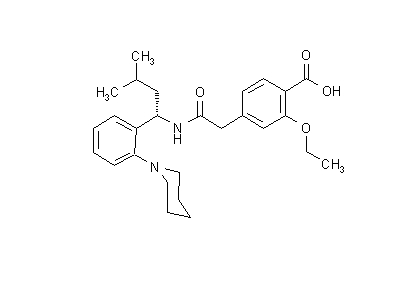
PRANDIN (R) (repaglinide) is an oral blood glucose-lowering drug of the meglitinide class used in the management of type 2 diabetes mellitus (also known as non-insulin dependent diabetes mellitus or NIDDM). Repaglinide, S(+)2-ethoxy-4(2((3-methyl-1-(2-(1-piperidinyl) phenyl)-butyl) amino)-2-oxoethyl) benzoic acid, is chemically unrelated to the oral sulfonylurea insulin secretagogues. The structural formula is as shown below: Repaglinide is a white to off-white powder with molecular formula C 27 H 36 N 2 O 4 and a molecular weight of 452.6. PRANDIN tablets contain 0.5 mg, 1 mg, or 2 mg of repaglinide. In addition each tablet contains the following inactive ingredients: calcium hydrogen phosphate (anhydrous), microcrystalline cellulose, maize starch, polacrilin potassium, povidone, glycerol (85%), magnesium stearate, meglumine, and poloxamer. The 1 mg and 2 mg tablets contain iron oxides (yellow and red, respectively) as coloring agents. Fig. 1 - Structural Formula of Prandin
PRANDIN is indicated as an adjunct to diet and exercise to improve glycemic control in adults with type 2 diabetes mellitus.
There is no fixed dosage regimen for the management of type 2 diabetes with PRANDIN. The patient's blood glucose should be monitored periodically to determine the minimum effective dose for the patient; to detect primary failure, i.e., inadequate lowering of blood glucose at the maximum recommended dose of medication; and to detect secondary failure, i.e., loss of an adequate blood glucose-lowering response after an initial period of effectiveness. Glycosylated hemoglobin levels are of value in monitoring the patient's longer term response to therapy. Short-term administration of PRANDIN may be sufficient during periods of transient loss of control in patients usually well controlled on diet. PRANDIN doses are usually taken within 15 minutes of the meal but time may vary from immediately preceding the meal to as long as 30 minutes before the meal. Starting Dose For patients not previously treated or whose HbA 1c is < 8%, the starting dose should be 0.5 mg with each meal. For patients previously treated with blood glucose-lowering drugs and whose HbA 1c is ? 8%, the initial dose is 1 or 2 mg with each meal preprandially (see previous paragraph). Dose Adjustment Dosing adjustments should be determined by blood glucose response, usually fasting blood glucose. Postprandial glucose levels testing may be clinically helpful in patients whose pre-meal blood glucose levels are satisfactory but whose overall glycemic control (HbA 1c ) is inadequate. The preprandial dose should be doubled up to 4 mg with each meal until satisfactory blood glucose response is achieved. At least one week should elapse to assess response after each dose adjustment. The recommended dose range is 0.5 mg to 4 mg taken with meals. PRANDIN may be dosed preprandially 2, 3, or 4 times a day in response to changes in the patient's meal pattern. The maximum recommended daily dose is 16 mg. Patient Management Long-term efficacy should be monitored by measurement of HbA 1c levels approximately every 3 months. Failure to follow an appropriate dosage regimen may precipitate hypoglycemia or hyperglycemia. Patients who do not adhere to their prescribed dietary and drug regimen are more prone to exhibit unsatisfactory response to therapy including hypoglycemia. When hypoglycemia occurs in patients taking a combination of PRANDIN and a thiazolidinedione or PRANDIN and metformin, the dose of PRANDIN should be reduced. Patients Receiving Other Oral Hypoglycemic Agents When PRANDIN is used to replace therapy with other oral hypoglycemic agents, PRANDIN may be started on the day after the final dose is given. Patients should then be observed carefully for hypoglycemia due to potential overlapping of drug effects. When transferred from longer half-life sulfonylurea agents (e.g., chlorpropamide) to repaglinide, close monitoring may be indicated for up to one week or longer. Combination Therapy If PRANDIN monotherapy does not result in adequate glycemic control, metformin or a thiazolidinedione may be added. If metformin or thiazolidinedione monotherapy does not provide adequate control, PRANDIN may be added. The starting dose and dose adjustments for PRANDIN combination therapy is the same as for PRANDIN monotherapy. The dose of each drug should be carefully adjusted to determine the minimal dose required to achieve the desired pharmacologic effect. Failure to do so could result in an increase in the incidence of hypoglycemic episodes. Appropriate monitoring of FPG and HbA 1c measurements should be used to ensure that the patient is not subjected to excessive drug exposure or increased probability of secondary drug failure.
PRANDIN is contraindicated in patients with: 1. Diabetic ketoacidosis, with or without coma. This condition should be treated with insulin. 2. Type 1 diabetes. 3. Co-administration of gemfibrozil. 4. Known hypersensitivity to the drug or its inactive ingredients.
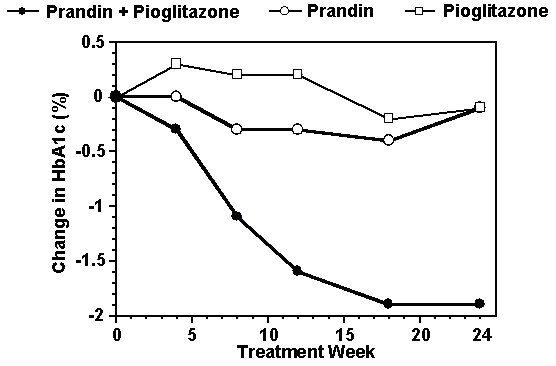
Hypoglycemia: See PRECAUTIONS and OVERDOSAGE sections. PRANDIN has been administered to 2931 individuals during clinical trials. Approximately 1500 of these individuals with type 2 diabetes have been treated for at least 3 months, 1000 for at least 6 months, and 800 for at least 1 year. The majority of these individuals (1228) received PRANDIN in one of five 1-year, active-controlled trials. The comparator drugs in these 1-year trials were oral sulfonylurea drugs (SU) including glyburide and glipizide. Over one year, 13% of PRANDIN patients were discontinued due to adverse events, as were 14% of SU patients. The most common adverse events leading to withdrawal were hyperglycemia, hypoglycemia, and related symptoms (see PRECAUTIONS ). Mild or moderate hypoglycemia occurred in 16% of PRANDIN patients, 20% of glyburide patients, and 19% of glipizide patients. The table below lists common adverse events for PRANDIN patients compared to both placebo (in trials 12 to 24 weeks duration) and to glyburide and glipizide in one year trials. The adverse event profile of PRANDIN was generally comparable to that for sulfonylurea drugs (SU). Commonly Reported Adverse Events (% of Patients) Events ? 2% for the PRANDIN group in the placebo-controlled studies and ? events in the placebo group EVENT PRANDIN PLACEBO PRANDIN SU N = 352 N = 108 N = 1228 N = 498 Placebo controlled studies Active controlled studies Metabolic Hypoglycemia 31 See trial description in CLINICAL PHARMACOLOGY , Clinical Trials 7 16 20 Respiratory URI 16 8 10 10 Sinusitis 6 2 3 4 Rhinitis 3 3 7 8 Bronchitis 2 1 6 7 Gastrointestinal Nausea 5 5 3 2 Diarrhea 5 2 4 6 Constipation 3 2 2 3 Vomiting 3 3 2 1 Dyspepsia 2 2 4 2 Musculoskeletal Arthralgia 6 3 3 4 Back Pain 5 4 6 7 Other Headache 11 10 9 8 Paresthesia 3 3 2 1 Chest pain 3 1 2 1 Urinary tract infection 2 1 3 3 Tooth disorder 2 0 <1 <1 Allergy 2 0 1 <1 Cardiovascular Events In one-year trials comparing PRANDIN to sulfonylurea drugs, the incidence of angina was comparable (1.8%) for both treatments, with an incidence of chest pain of 1.8% for PRANDIN and 1.0% for sulfonylureas. The incidence of other selected cardiovascular events (hypertension, abnormal EKG, myocardial infarction, arrhythmias, and palpitations) was ? 1% and not different between PRANDIN and the comparator drugs. The incidence of total serious cardiovascular adverse events, including ischemia, was higher for repaglinide (4%) than for sulfonylurea drugs (3%) in controlled comparator clinical trials. In 1-year controlled trials, PRANDIN treatment was not associated with excess mortality when compared to the rates observed with other oral hypoglycemic agent therapies. Summary of Serious Cardiovascular Events (% of total patients with events) in Trials Comparing PRANDIN to Sulfonylureas PRANDIN SU glyburide and glipizide Total Exposed 1228 498 Serious CV Events 4% 3% Cardiac Ischemic Events 2% 2% Deaths due to CV Events 0.5% 0.4% Seven controlled clinical trials included PRANDIN combination therapy with NPH-insulin (n=431), insulin formulations alone (n=388) or other combinations (sulfonylurea plus NPH-insulin or PRANDIN plus metformin) (n=120). There were six serious adverse events of myocardial ischemia in patients treated with PRANDIN plus NPH-insulin from two studies, and one event in patients using insulin formulations alone from another study. Infrequent Adverse Events (<1% of Patients) Less common adverse clinical or laboratory events observed in clinical trials included elevated liver enzymes, thrombocytopenia, leukopenia, and anaphylactoid reactions. Although no causal relationship with repaglinide has been established, postmarketing experience includes reports of the following rare adverse events: alopecia, hemolytic anemia, pancreatitis, Stevens-Johnson Syndrome, and severe hepatic dysfunction including jaundice and hepatitis. Combination Therapy with Thiazolidinediones During 24-week treatment clinical trials of PRANDIN-rosiglitazone or PRANDIN-pioglitazone combination therapy (a total of 250 patients in combination therapy), hypoglycemia (blood glucose < 50 mg/dL) occurred in 7% of combination therapy patients in comparison to 7% for PRANDIN monotherapy, and 2% for thiazolidinedione monotherapy. Peripheral edema was reported in 12 out of 250 PRANDIN-thiazolidinedione combination therapy patients and 3 out of 124 thiazolidinedione monotherapy patients, with no cases reported in these trials for PRANDIN monotherapy. When corrected for dropout rates of the treatment groups, the percentage of patients having events of peripheral edema per 24 weeks of treatment were 5% for PRANDIN-thiazolidinedione combination therapy, and 4% for thiazolidinedione monotherapy. There were reports in 2 of 250 patients (0.8%) treated with PRANDIN-thiazolidinedione therapy of episodes of edema with congestive heart failure. Both patients had a prior history of coronary artery disease and recovered after treatment with diuretic agents. No comparable cases in the monotherapy treatment groups were reported. Mean change in weight from baseline was +4.9 kg for PRANDIN-thiazolidinedione therapy. There were no patients on PRANDIN-thiazolidinedione combination therapy who had elevations of liver transaminases (defined as 3 times the upper limit of normal levels).
Drug-Drug Interactions In vitro data indicate that PRANDIN is metabolized by cytochrome P450 enzymes 2C8 and 3A4. Consequently, repaglinide metabolism may be altered by drugs which influence these cytochrome P450 enzyme systems via induction and inhibition. Caution should therefore be used in patients who are on PRANDIN and taking inhibitors and/or inducers of CYP2C8 and CYP3A4. The effect may be very significant if both enzymes are inhibited at the same time resulting in a substantial increase in repaglinide plasma concentrations. Drugs that are known to inhibit CYP3A4 include antifungal agents like ketoconazole, itraconazole, and antibacterial agents like erythromycin. Drugs that are known to inhibit CYP2C8 include agents like trimethoprim, gemfibrozil and montelukast. Drugs that induce the CYP3A4 and/or 2C8 enzyme systems include rifampin, barbiturates, and carbamezapine. See CLINICAL PHARMACOLOGY section, Drug-Drug Interactions . Repaglinide appears to be a substrate for active hepatic uptake transporter (organic anion transporting protein OATP1B1). Drugs that inhibit OATP1B1 (e.g. cyclosporine) may likewise have the potential to increase plasma concentrations of repaglinide. See CLINICAL PHARMACOLOGY section, Drug-Drug Interactions . In vivo data from a study that evaluated the co-administration of a cytochrome P450 enzyme 3A4 inhibitor, clarithromycin, with PRANDIN resulted in a clinically significant increase in repaglinide plasma levels. In addition, an increase in repaglinide plasma levels was observed in studies that evaluated the co-administration of PRANDIN with trimethoprim and PRANDIN with deferasirox, both cytochrome P-450 enzyme 2C8 inhibitors. These increases in repaglinide plasma levels may necessitate a PRANDIN dose adjustment. See CLINICAL PHARMACOLOGY section, Drug-Drug Interactions . Gemfibrozil significantly increased PRANDIN exposure. Therefore, patients should not take PRANDIN with gemfibrozil. See CLINICAL PHARMACOLOGY section, Drug-Drug Interactions , and CONTRAINDICATIONS . The hypoglycemic action of oral blood glucose-lowering agents may be potentiated by certain drugs including nonsteroidal anti-inflammatory agents and other drugs that are highly protein bound, salicylates, sulfonamides, cyclosporine, chloramphenicol, coumarins, probenecid, monoamine oxidase inhibitors, and beta adrenergic blocking agents. When such drugs are administered to a patient receiving oral blood glucose-lowering agents, the patient should be observed closely for hypoglycemia. When such drugs are withdrawn from a patient receiving oral blood glucose-lowering agents, the patient should be observed closely for loss of glycemic control. Certain drugs tend to produce hyperglycemia and may lead to loss of glycemic control. These drugs include the thiazides and other diuretics, corticosteroids, phenothiazines, thyroid products, estrogens, oral contraceptives, phenytoin, nicotinic acid, sympathomimetics, calcium channel blocking drugs, and isoniazid. When these drugs are administered to a patient receiving oral blood glucose-lowering agents, the patient should be observed for loss of glycemic control. When these drugs are withdrawn from a patient receiving oral blood glucose-lowering agents, the patient should be observed closely for hypoglycemia.